One purpose of this appendix is to derive some illuminating, and possibly useful, expressions for the expectation values of the energies of two kinds of physical systems. The first comprises multiple interacting indistinguishable particles, such as electrons, confined by a potential, such as the electrostatic potential from a set of quasi-static nuclei. The second physical system is a non-overlapping interacting pair of charge-neutral composite particles, such as nanoparticles or noble gas atoms.
A second purpose of this appendix is to use these examples to illustrate how much can be learned about the structure of a generic pure statistical state $\Psi$ of a physical system or subsystem $\subject$ by expressing the expectation values of $\subject$’s observables in basis sets that are intrinsic properties of state ${\Psi}$, rather than eigenstates of the observables’ operators.
The eigenstates of the operator $\hObs$ of an observable $\Obs$ inherit their characteristics from three sources: Namely, the observable $\Obs$, the physical system $\subject$ of which they are statistical states, and the apparatus or probe to which $\subject$ is coupled during the measurement of $\Obs$. Therefore, they are not necessarily representative of an arbitrary pure state of $\subject$. However, even if they were, there is nothing general to be learned about pure states from an expression for the expectation value ${\expval{\Obs}}$ of $\Obs$ that is derived by expanding an arbitrary pure state $\Psi$ in a basis of eigenstates of ${\hObs}$: For every observable, this procedure leads to the classical expression,
where each ${\obs_\alpha}$ is one of the possible results of measuring ${\Obs}$.
This work demonstrates by example that it is possible to gain insight into characteristics of an arbitrary pure state $\Psi$ by expressing expectation values of its observables in terms of its natural basis sets, which are basis sets whose elements are natural states. A pure state’s natural states are the eigenstates of its reduced density matrices; and their eigenvalues are their occupation numbers [Coleman, 1963; Löwdin, 1955; Davidson, 1972; Ando, 1963; McWeeny, 1960].
All of the theory that is presented or developed in this appendix is applicable to a pure state of a set of classical particles whose energy expectation value can be expressed as the expectation value of a sum of $1$-particle energies and $2$-particle interaction energies. Although, I briefly express the $1$-particle energy in the form that it would take for a set of quantum mechanical particles in an external potential, my derivations do not require it to have this form.
I.1 Pure states and mixed states
I.1.1 Pure states
A pure state of a classical or quantum mechanical system $\subject$ that comprises $N$ indistinguishable particles is a function ${\Psi\in\lebesgue(\domain^N)}$ such that
is the probability distribution for the system’s microstructure, ${(x_1\cdots x_N)}$, where ${x_i\in\domain}$ specifies the coordinates of the ${i^\text{th}}$ particle; and ${\domain}$ is the set of all possible coordinates of a single particle. For example, if ${\domain=\realone^3}$, ${\pdf(x_1\cdots x_N)}$ is a position probability density function and each element of ${\domain}$ is a point in physical space and a possible location of a particle.
The pure state specified by $\Psi$ will sometimes be represented by an element ${\ket{\Psi}}$ of an abstract Hilbert space ${\hilbert_N}$, whose elements are in one to one correspondence with the elements of ${\lebesgue(\domain^N)}$. It can also be specified by an idempotent density operator,
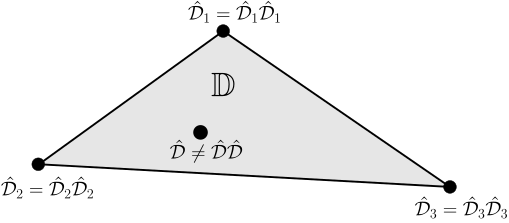
Figure 20. Schematic depiction of the set $\ddomain$ of all density operators. Its
vertices are idempotent, and therefore pure states; and every interior point ${\Dop}$
is a mixed state, which can be expressed
as ${\Dop=\weight_1\Dop_1+\weight_2\Dop_2+\weight_3\Dop_3}$, where
${\weight_1,\weight_2,\weight_3\in(0,1)}$ and
${\weight_1+\weight_2+\weight_3=1}$. Set $\ddomain$ is defined by the pure states, just
as a triangle is defined by its vertices.
The set of all density operators, $\ddomain$, is the set of all positive Hermitian operators ${\hilbert_N\to\hilbert_N}$ with unit trace. It is a convex set [Coleman, 1963; von Neumann et al., 2018; von Neumann, 1955], which means that
Convexity of ${\ddomain}$ implies that if ${\ddomain}$ is visualized as a simplex, as it is depicted in Fig. 20, an element of ${\ddomain}$ is a pure state if and only if it is at a vertex of the simplex. Therefore the set of pure state density operators is the set of extreme points of $\ddomain$; and convexity implies that the set of extreme points (vertices) defines the entire set. Therefore, as pointed out by [Coleman, 1963], we can hope to understand a great deal about an arbitrary mixed state of $\subject$ by understanding an arbitrary pure state of ${\subject}$.
I.2 Notation, definitions, and assumptions
The notation in this appendix deviates from the convention, introduced in Appendix I.2 and used throughout the rest of this work, that ${x}$ or ${x_i}$ represents a single coordinate of a particle’s position vector. In this appendix a single variable, such as $x$, $y$, $x_i$ or $y_j$ denotes all of a single particle’s coordinates; and in Appendix I.4 I will often use $i$ to denote $x_i$.
For simplicity it is assumed in Appendix I.5 that all particles are either spin-0 electrons or spin-0 nuclei, whose coordinates are simply their positions. However, no assumptions are made that are inconsistent with classical physics. Therefore the particles referred to as ‘electrons’ represent any set of indistinguishable charged light particles, and those referred to as ‘nuclei’ represent any set of oppositely-charged indistinguishable heavy particles.
In Appendix I.3 and Appendix I.4, if the particles have spins the $i^\text{th}$ particle’s coordinates will be ${i\equiv x_i\equiv(\rvecsub{i},\spin_i)}$, where $\rvecsub{i}$ is its position and $\spin_i$ is its spin; and I will often use the abbreviation ${\dmeasure{1\cdots p}\equiv\dd{x_1}\cdots\dd{x_p}}$. I do not discuss magnetization, particles’ spins, or magnetic interactions explicitly; and all of the theory presented is applicable to charged spin-$0$ particles. However, if the theory is applied to particles with spins, integrals over the coordinates of one or more particles denote a sum over all possible (sets of) spins of the integral over all possible (sets of) positions. For example,
The meaning of ${\ket{x}}$ was explained in Appendix C the general case in which $x$ represents $\Ndof$ degrees of freedom, but no account was taken of the degrees of freedom of a single particle it can be thought of as the tensor product of the state vectors of those degrees of freedom.
For example, if ${\rvec\in\realone^3}$, and if $x$ momentarily represents the $x$-coordinate of $\rvec$, then ${\ket{\rvec}}$ should be thought of as
or as a tensor product, in any other order, of the three states that represent the same particle’s Cartesian position coordinates. The order does not matter as long as the same order is used consistently for all particles.
Therefore, from now on, ${\ket{x}}$ is an element of ${\hilbert_1}$ that represents a possible configuration of a single particle; and just as ${\hilbert_N}$ is an abstract representation of ${\lebesgue(\domain^N)}$, ${\hilbert_1}$ is an abstract representation of ${\lebesgue(\domain)}$. Therefore if, for example, ${\domain\equiv\onetorus}$, then ${\ket{x}}$ also represents a square integrable function that is localized around ${x\in\onetorus}$. If the width $\dwidth$ of that function vanished, it would be the Dirac delta distribution. However its width is arbitrarily small, but finite.
The vector ${\ket{x_1\cdots x_p}\in\hilbert_p}$, where ${\hilbert_p}$ is an abstract representation of ${\lebesgue(\domain^p)}$, is defined as
where I will be using operator $\antisymmetrizer$ in multiple vector spaces to denote the norm-preserving antisymmetriser.
Note that a tensor product of multiple states is only antisymmetrized if each state refers to a different particle. It was not needed for the definition ${\ket{\rvec}=\ket{x}\otimes\ket{y}\otimes\ket{z}}$.
Since the space $\domain$ has not been specified, it would be unnecessarily complicated to be specific and rigorous about the normalizations of states like ${\ket{x_1\cdots x_p}}$. It suffices to consider the expression,
where ${\delta}$ plays the same role within integrals over ${\domain}$ that is played by Dirac’s delta function, when it is in the hands of physicists. This expression is inappropriate and problematic in several ways, but it is fine for present purposes. It is implied by the equally-problematic expression ${\braket{x}{x'}=\delta(x-x')}$ and the fact that $\antisymmetrizer$ preserves normalizations.
A natural $p$-state${\mathcal{X}_\alpha(x_1,\cdots,x_p)}$ of an isolated system of ${N=p+q}$ identical particles in a pure state, ${\Psi(x_1,\cdots,x_{N})\in\hilbert_N}$, is an eigenstate of its $p^\text{th}$-order reduced density matrix (or simply ${p}$-matrix). That is,
Natural states have many nice properties. For example, if ${\{\tilde{\mathcal{X}}_\alpha\}}$ and ${\{\tilde{\mathcal{Y}}_\beta\}}$ are not sets of natural states, but are any other complete orthonormal bases of the ${p}$-particle and ${q}$-particle Hilbert spaces, respectively, then ${\Psi}$ can be expressed exactly as the double infinite sum
for some set of constants ${\tilde{C}_{\alpha\beta}\in \mathbb{C}}$. However if ${\{\mathcal{X}_\alpha\}}$ and ${\{\mathcal{Y}_\beta\}}$ are the sets of natural $p$-states and $q$-states, this expression simplifies to the single infinite sum,
where ${C_\alpha\in\complex}$ and ${\mathcal{X}_\alpha}$ and ${\mathcal{Y}_\alpha}$ are eigenstates of the $p$-matrix and the $q$-matrix, respectively, with the same eigenvalue, ${\lambda_\alpha\equiv \abs{C_{\alpha}}^2}$. Furthermore,
which means that ${C_\alpha\mathcal{Y}_\alpha}$ is the contraction of ${\bar{\mathcal{X}}_\alpha}$ onto ${\Psi}$.
Therefore ${\mathcal{Y}_\alpha}$ resides in the Hilbert subspace that is orthogonal to $\mathcal{X}_\alpha$. Eq. (163) also means that both ${\mathcal{X}_\alpha}$ and ${\mathcal{Y}_\alpha}$ inherit from $\Psi$ its symmetry or antisymmetry with respect to exchange of positions.
I refer the reader to [Coleman, 1963] for a clear explanation of many of the nice properties of natural states. These properties suggest that natural $p$-states are the only ${p}$-particle states to which physical meaning should be attached in a system comprised of more than $p$ particles. I state only two of these properties here.
Property 1:
It can be shown (see Coleman’s Theorem 3.1) that if ${\Phi}$ is restricted to the mathematical form
where ${u\leq v<\infty}$, and if ${\norm{\Psi-\Phi}^2}$ is minimized with respect to the set of coefficients ${\{\tilde{C}_{\alpha\beta}\}}$ and the sets of functions, ${\{\tilde{\mathcal{X}}_{\alpha}\}_{\alpha\leq u}}$ and ${\{\tilde{\mathcal{Y}}_{\beta}\}_{\beta\leq v}}$, the minimum is obtained by the following truncation of the sum in Eq. (162):
There is a long history of simplifying many-particle states and many-particle energetics by treating the particles as quasi-independent; and approximations based on this simplification are widely used. The purpose of this subsection is to present a rigorous theoretical justification of the concept of a quasi-independent particle state in some many-particle systems; and to provide insight into the conditions under which this concept ceases to be meaningful or justified.
It is hoped that this may lead to a better understanding of how Bloch functions, Wannier functions, and other kinds of single particle states should be interpreted; and a better understanding of the validity of the assumption that the electron densities of atoms and chemical bonds have substructures of atomic and molecular orbitals.
The justification that is presented consists of a derivation of a few closely-related exact expressions for the energy
where the first sum is over the set ${\{\varphi_\alpha\}}$ of all of $\Psi$’s natural orbitals (natural $1$-states); the second sum is over all distinct pairs of natural orbitals; the set ${\{\occ_\alpha\}}$, which is uniquely determined by $\Psi$, has the properties ${\occ_\alpha\in[0,1]}$ and ${\sum_\alpha \occ_\alpha =N}$ that would be required of orbital occupation probabilities; ${\energy_\alpha}$ denotes ${\expvaltwo{\hamsmall}{\varphi_\alpha}}$, where ${\hamsmall}$ is a $1$-particle Hamiltonian; and
where ${\what_{\alpha\beta}}$ can be viewed as a coupling between natural orbitals ${\varphi_\alpha}$ and ${\varphi_\beta}$ that is mediated by the ${(N-1)}$-particle states ${\ket{\Theta_\alpha}\equiv\lcontractN{\varphi_\alpha}{\Psi}}$ and ${\ket{\Theta_\beta}\equiv\lcontractN{\varphi_\beta}{\Psi}}$.
Eq. (165) is an exact expression for the energy of a set of $N$ interacting indistinguishable particles in a pure state as a weighted sum of the energies ${\{\energy_\alpha\equiv\expvaltwo{\hamsmall}{\varphi_\alpha}\}}$ of independent particles whose wavefunctions are the natural orbitals (natural $1$-states) ${\{\varphi_\alpha\}}$ of $\Psi$, plus an interaction term.
The interaction term is a weighted sum of the terms ${\left\{w_{\alpha\beta}\right\}}$, which have the appearance of pairwise couplings between orbitals. However $\what_{\alpha\beta}$ depends on the natural ${(N-1)}$-states ${\Theta_\alpha}$ and ${\Theta_\beta}$ that are the dual states of ${\varphi_\alpha}$ and ${\varphi_\beta}$, respectively. Therefore ${\mel{\varphi_\alpha}{\what_{\alpha\beta}}{\varphi_\beta}}$ is not a $2$-particle term, but an $N$-particle term, which it might be appropriate to interpret as a mediated coupling between orbitals $\varphi_\alpha$ and $\varphi_\beta$, or as a mediated interaction between two particles occupying them.
If all of the interaction energies were sufficiently small, $E$ could be interpreted as approximately a weighted sum of the energies of independent particles occupying different orbitals, where the weight given to each energy is both the probability of the corresponding orbital being occupied at a particular instant and the fraction of time for which it is occupied. Then ${\{w_{\alpha\beta}\}}$ could be interpreted as the set of energies of the interactions responsible for moving particles between orbitals.
Therefore, when interaction energies are small, Eq. (165) is consistent with the physical picture of each particle occupying an orbital for a long period until, eventually, its weak or rare interactions with other particles move it to a different orbital. On the other hand, the fact that ${w_{\alpha\beta}}$ is an $N$-particle energy means that when interaction energies are large, $E$ is not approximately a sum of single particle energies. In that case, Eq. (165) is consistent with the residence times of particles in orbitals being too short for the concept of orbital occupation to be valid.
The derivation of Eq. (165) makes use of properties possessed only by the set natural orbitals. Therefore it strengthens the case for natural orbitals being the most ‘physical’ $1$-particle states in a many particle system, and suggests that comparisons with natural orbitals might shed light on how other sets $1$-particle states should be interpreted.
where ${\{\varphi_\alpha\}}$ and ${\{\Theta_\alpha\}}$ are the sets of natural orbitals and natural ${(N-1)}$-states, respectively, and the functions in each set are mutually orthogonal and have been chosen to be normalized to one, i.e., ${\braket{\varphi_\alpha}{\varphi_\beta}=\delta_{\alpha\beta}}$ and ${\braket{\Theta_\alpha}{\Theta_\beta}=\delta_{\alpha\beta}}$. Let us also choose ${\Psi}$ to be normalized to one, which implies that ${\sum_\alpha\lambda_\alpha=1}$, where ${\lambda_\alpha\equiv\abs{c_\alpha}^2}$.
Both $\Hamone$ and $\Hamtwo$ operate on $N$-particle states, but are sums of $1$-particle operators and $2$-particle operators, respectively. The independent-particle Hamiltonian, $\Hamone$, is a sum over $i$ of the single-particle Hamiltonian, ${\hamsmall(i)}$, which operates on the coordinates of the ${i^\text{th}}$ particle.
The interaction term has the form ${\Hamtwo=\sum_{i,j>i}\hamtwo(i,j)}$, where ${\hamsmalltwo(i,j)}$ is the interaction between particles with coordinates $i$ and $j$. I will use ${\Hamtwo}$ more generally to denote the interaction operator of a system with $M$ particles, where $M$ is the number of particles of the state on which ${\Hamtwo}$ acts.
Eq. (165) and the other expressions for ${\expvaltwo{\Ham}{\Psi}}$ that will be derived in this section (Appendix I.4), are quite general. They are valid for any set of indistinguishable classical or quantum mehcanical particles and any operator $\Ham$ that can be expressed as a sum of $1$-particle and $2$-particle terms. Nevertheless, I will sometimes refer to the particles as electrons and I will assume that the $1$-particle operator has the form, ${\hamsmall(i)= \kinetic(i) + \vextop(i)}$, where $\kinetic$ is the $1$-particle kinetic energy operator; and $\vextop$ is the operator for the energy of a single particle in an external potential.
I.4.2 Single particle energy
Eq. (166) can be used to express the expectation value of the $1$-particle energy as
where ${\occ_\alpha \equiv N\lambda_\alpha \equiv N\abs{c_\alpha}^2}$; ${\energy_\alpha\equiv t_\alpha+\vext_\alpha}$; and I have introduced the $1$-particle energy expectation values, ${t_\alpha \equiv \expvaltwo{\,\hat{t}\,}{\varphi_\alpha}}$ and
where ${n_\alpha(x)\equiv\abs{\varphi_\alpha(x)}^2}$; ${\vextop_\alpha\equiv \int \vext(1)\dyad{1}\dmeasure{1}}$; and ${\vext(1)=\vext(x_1)}$ is the external potential felt by a single particle whose coordinates are $x_1$.
The exchange symmetries of ${\Psi^*\Psi}$ and ${\bar{\Theta}_\alpha\Theta_\beta}$ allow the sum of interactions ${\hamtwo(i,j)}$ in parentheses to be replaced by any of the following three expressions:
and this definition would lead to the expressions presented in Appendix I.4.5. However, because the magnitudes of the coupling energies ${\{w_{\alpha\beta}\}}$ determine whether or not orbital occupation is a valid concept, let us choose a path by which it can be expressed in a simpler mathematical form. Without losing generality, let us choose the coefficients ${\{c_\alpha\}}$ to be real. This is possible because we can express ${c_\alpha\varphi_\alpha}$ as
Therefore the phase factors of the coefficients ${\{c_\alpha\}}$ can be merged into the natural orbitals. Having done so, we can define the coupling energy between ${\varphi_\alpha}$ and ${\varphi_\beta}$ as
This expression makes it clear that ${\vmf_\alpha}$ is the mean field interaction between an electron in orbital ${\varphi_\alpha}$ and ${N-1}$ electrons in $\varphi_\alpha$’s dual ${(N-1)}$-state, $\Theta_\alpha$.
If the coefficients ${\{c_\alpha\}}$ are real, expressing ${N c_\alpha c_\beta}$ as ${\sqrt{\occ_\alpha\occ_\beta}}$ implies that they are positive as well as real. However, none of these expressions, except the final one in which ${\sqrt{\occ_\alpha\occ_\beta}}$ has been replaced by ${ N c_\alpha c_\beta}$ rather than by ${N \bar{c}_\alpha c_\beta}$, would be different if the coefficients ${\{c_\alpha\}}$ were complex and ${w_{\alpha\beta}}$ had been defined as in Eq. (173).
Note that if the phase factors of the natural ${(N-1)}$-states were independent of particles’ positions and spins, they could be merged into the natural orbitals. Then ${\what_{\alpha\beta}}$ could be expressed as
is the probability density that a set of ${(N-1)}$ particles whose wavefunction is ${\Theta_\alpha}$ have configuration ${(x_2\cdots x_N)}$. The reason to express ${\what_{\alpha\beta}}$ in this form is to show that the integrand on the right hand side of Eq. (176) is the product of ${\hamtwo(x_1,x_2)}$ and the geometric mean of ${\pdenarg{\Theta}_\alpha(x_2\cdots x_N)}$ and ${\pdenarg{\Theta}_\beta(x_2\cdots x_N)}$.
I.4.4 Interaction energy - Expression 2
Another expression for $W$ can be found by inserting Eq. (170) into Eq. (169). Then the definition of ${\what_{\alpha\beta}}$ can be used to simplify the first term, and ${\braket{\varphi_\alpha}{\varphi_\beta}=\delta_{\alpha\beta}}$ can be used to simplify the second term, to give
Note that the first term on the right hand side only differs from right hand side of Eq. (172) by a factor of $N$. Therefore we can replace it with the right hand side of Eq. (175) divided by $N$, i.e.,
where ${\Walpha}$ is the total interaction energy of ${N-1}$ particles whose state is ${\Theta_\alpha}$. The first part of this expression is an occupation-weighted sum of the natural orbital energy $\energy_\alpha$ plus one electron’s share of (i.e., ${\frac{1}{N}\times}$) the mean field interaction between an electron in orbital $\varphi_\alpha$ and the ${N-1}$ remaining electrons in state ${\Theta_\alpha}$ plus one electron’s share of the energy ${\Walpha}$ of interaction between the electrons in state ${\Theta_\alpha}$. The second part of the expression could also be expressed as
It can be interpreted as a correlation term to correct the sum ${\sum_\alpha \lambda_\alpha \vmf_\alpha}$ of mean field interactions between the electron in orbital $\varphi_\alpha$ and the electrons in state ${\Theta_\alpha}$.
where ${\breve{\varphi}_\alpha(\alpha)}$ denotes the absence of ${\varphi_\alpha(\alpha)}$ in the product, e.g., ${\varphi_1\breve{\varphi}_2\varphi_3=\varphi_1\varphi_3}$.
This demonstrates that, within the Hartree-Fock approximation, ${\what_{\alpha\beta}(x)}$ is the mean field potential at $x$ from the density ${n-n_\alpha-n_\beta}$, which is the number density of $\Psi$ minus the contribution to it from orbitals $\varphi_\alpha$ and ${\varphi_\beta}$. In other words, the coupling between state ${\ket{\varphi_\alpha}}$ and ${\ket{\varphi_\beta}}$ is mediated by a mean field potential, which does not include a self interaction.
I.4.7 Summary
The theory presented in Appendix I.4 may be important in many contexts, but it has been developed and presented with chemical bonding in mind, where the term chemical is intended to mean that the attraction between the bonded atoms occurs due to a substantial redistribution of the atoms’ electron densities.
The next section is concerned with attractions between atoms, surfaces, nanoparticles, or other objects that can occur without substantial redistribution of the objects’ electron densities, because it is the attraction due to dynamical correlation of the objects’ constituent particles.
I.5 Non-overlapping bodies
This section presents one way to understand the forces and torques exerted by two unmagnetized charge-neutral bodies on one another when they do not overlap spatially and do not exchange particles. The bodies could be atoms, molecules, nanoparticles, or any other objects composed of more than one charged particle. Therefore they will be referred to as C-particles, where ‘C’ abbreviates composite, and they will be identified individually as CP1 and CP2. The isolated system comprised only of CP1 and CP2 will be referred to as CP1+CP2.
For simplicity it will be assumed that each C-particle is composed of only two species of more elementary particle; namely, nuclei of atomic number $Z$ and electrons.
The only approximation made in this section is the neglect of overlap of the CP’s wavefunctions.
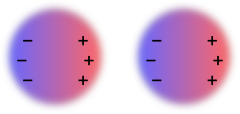
Figure 21. A pair of charge-neutral composite particles polarize to lower their potential energy.
I.5.1 Macroscopic charge distributions and their ensembles
Since CP1 and CP2 are not charged, the forces and torques they exert on one another arise from non-uniformities of their charge distributions. For example, the C-particles depicted in Fig. 21 attract one another because they have polarized such that each one has a dipole moment that is directed from left to right. They would also attract one another if they both had opposite (left to right) linear polarizations, or for any number of other more complex charge distributions, ${\pden=\pdenup{1}+\pdenup{2}}$, of CP1+CP2.
In general, non-uniformities can be either static or dynamic. Static non-uniformities are non-uniformities of their time-averaged charge distributions, and dynamic non-uniformities are transient and arise from interaction-biased quasi-random fluctuations of the CP’s microstructures. The focus of this section is on dynamic uniformities, and I will refer to the energy and force of interaction between the CPs arising from the dynamic uniformities as the correlation energy and force, despite the fact that there also exist intra-CP correlations.
If the fluctuations of the microstructures of CP1 and CP2 were independent of one another, the probabilities of the net correlation force being repulsive and attractive at a given instant would be equal, and the time average of the net correlation force would vanish.
However, their charge distributions do not change independently of one another, and we will see that the energy of CP1+CP2 can be expressed as
\begin{align*}
E= E_1+E_2+\Eint,
\end{align*}
where ${\Eint}$ is the energy of interaction between them.
I.5.2 Notation
The variables $x_i$ and $y_j$ specify the cooordinates of the $i^\text{th}$ constituent particle of CP1 and the ${j^\text{th}}$ constituent particle of CP2, respectively, and $\interact{x_i}{y_j}$ denotes the Coulomb repulsion between particles with coordinates $x_i$ and $y_j$ if their charges are both either $e$ or $-e$.
The vector ${X\equiv (x_1\cdots x_p)}$ specifies the coordinates of all $p$ constituent particles of CP1 and ${Y\equiv (y_1\cdots y_q)}$ specifies the coordinates of all $q$ constituent particles of CP2.
Integrals will continue to incorporate sums over spin configurations and the abbreviations ${\dmeasureA{i_1\cdots i_m}\equiv\dd{x_{i_1}}\cdots\dd{x_{i_m}}}$ and ${\dmeasureB{i_1\cdots i_m}\equiv\dd{y_{j_1}}\cdots\dd{y_{j_n}}}$ will be used. For example,
where ${\{s_1\cdots s_N\}\equiv\{x_1,x_2\cdots x_p,y_1\cdots y_q\}}$; ${\{\wx_\alpha\}}$ and ${\{\wy_\alpha\}}$ are the sets of all natural $p$-states and $q$-states, respectively; and the dual of $p$-state $\wx_\alpha$ is the $q$-state $\wy_\alpha$.
Although $\Psi$ is antisymmetric, the C-particles do not overlap significantly. Furthermore, as the distance between them increases, the rates at which particles move between them decrease, while the characteristic time and length scales of fluctuations of their charge distributions that are capable of producing significant relative forces and torques increase. Therefore let us make the physical assumption that the particles are at a separation $r$ for which there exists a time scale $\tau$ such that the average frequency with which particles travel between them is much smaller than ${1/\tau}$, and the time scale of the charge redistribution processes responsible for their relative forces and torques is much smaller than $\tau$.
Under this assumption, and since the degree of overlap between CP1 and CP2 is negligible, it does not change the energy or the expectation value of any observable if $\Psi$ is chosen to not have the correct (anti-)symmetry with respect to exchange of coordinates between CP1 and CP2. Therefore $\Psi$ can be expressed as (see Appendix I.3 or [Coleman, 1963])
The sets ${\{\wx_\alpha(X)\}}$ and ${\{\wy_\alpha(Y)\}}$ are orthonormal, meaning that ${\braket{\wx_\alpha}{\wx_\beta}=\delta_{\alpha\beta}}$ and ${\braket{\wy_\alpha}{\wy_\beta}=\delta_{\alpha\beta}}$, and their elements have the appropriate symmetry with respect to interchange of any two identical particles on the same C-particle. For example if $x_i$ and $x_j$ are the coordinates of electrons on CP1, then
The Hamiltonian of CP1+CP2 can be expressed as ${\Ham = \Ham_1 + \Ham_2 + \Hamint}$, where $\Ham_1$ and $\Ham_2$ are the Hamiltonians of CP1 and CP2, respectively, and $\Hamint$ is the interaction between them. Using the notation
where ${\Eint\equiv\expvaltwo{\Hamint}{\Psi}}$ is the energy of interaction between CP1 and CP2; and ${\CPenergy{1}_\alpha\equiv\expvaltwo{\Ham_1}{\wx_\alpha}}$ and ${\CPenergy{2}_\alpha\equiv\expvaltwo{\Ham_2}{\wy_\alpha}}$ are the expectation values of $\Ham_1$ and ${\Ham_2}$, respectively, when the state $\ket{\wx_\alpha}$ of CP1 is the $\alpha^\text{th}$ natural $p$-state of $\ket{\Psi}$ and the state ${\ket{\wy_\alpha}}$ of CP2 is the natural ${q}$-state of ${\ket{\Psi}}$ that is ${\ket{\wx_\alpha}}$’s dual state, i.e.,
where ${\Eintcp{+-}}$ denotes the energy of interaction between the nuclei of CP1 and the electrons of CP2; ${\Eintcp{-+}}$ denotes the energy of interaction between the electrons of CP1 and the nuclei of CP2; and ${\Eintcp{--}}$ and ${\Eintcp{++}}$ denote the energies of interaction between CP1 and CP2 that only involve electrons and nuclei, respectively. An expression for ${\Eintcp{+-}}$ will now be derived, and expressions for ${\Eintcp{-+}}$, ${\Eintcp{--}}$, and ${\Eintcp{++}}$ that could be derived by a similar route will then be presented.
Let ${\sxn}$ and ${\sxe}$ denote the sets of all indices $i$ for which ${x_i}$ is the coordinate of one of CP1’s nuclei and electrons, respectively; and let ${\syn}$ and ${\sye}$ denote the sets of all indices $j$ for which $y_j$ is one of CP2’s nuclei and electrons, respectively. Then the interaction between CP1’s nuclei and CP2’s electrons can be expressed as
where ${\numpx}$ denotes the number of nuclei in CP1, ${\nummy}$ denotes the number electrons in CP2; and the symmetry of ${\abs{\Psi}^2}$ with respect to exchange of identical particles belonging to the same CP has been used to reach the second expression from the first.
Eq. (183) will be simplified by expressing it in terms of position probability density functions (pdfs). First, the notation used to identify pdfs, joint pdfs, and condition pdfs will be introduced.
Notation for probability density functions (pdfs):
The joint probability density that one of CP1’s nuclei is at $x$ and one of CP2’s electrons is at $y$ is
More generally, ${\den_{\scriptscriptstyle ss'}(x,y)}$, where ${s,s'\in\{+,-\}}$, will denote the joint probability density that one of CP1’s particles of type ${s}$ is at $x$ and one of CP2’s particles of type ${s'}$ is at $y$, where particles of type ‘$+$’ are nuclei and those of type ‘$-$’ are electrons.
Let ${\denargp{i}}$ and ${\denargm{i}}$ denote the number densities of CPi’s nuclei and electrons, respectively, where ${\text{CPi}\in\{\text{CP1},\text{CP2}\}}$. For example, ${\denargm{2}(y)}$ is the probability density that one of CP2’s electrons is at $y$, which implies that ${\int\dd{y}\denargm{2}(y)=\nummy}$.
Let ${\den^{\scriptscriptstyle (i)}_{\scriptscriptstyle s|s'}(u|v)}$, where ${s, s'\in \{-,+\}}$, denote the conditional probability density that one of CPi’s particles of type $s$ is at $u$given that one of the other CP’s particles of type $s'$ is at $v$. For example, ${\dencmp{2}(y|x)}$ is the conditional probability density that one of CP2’s electrons is at $y$, given that one of CP1’s nuclei is at $x$; and ${\dencmm{1}(x|y)}$ is the conditional probability density that one of CP1’s electrons is at $x$ given that one of CP2’s electrons is at $y$.
which I will now begin to use extensively. The function $f$ that occupies the first slot of ${\bbraket{\,\cdot\,}{\,\cdot\,}}$ will always be a position pdf for CP1’s nuclei or electrons, and the function $g$ in the second slot will always be a position pdf for CP2’s nuclei or electrons. Either $f$ or $g$ may or may not be a conditional pdf, i.e., ${f=f(x|y)}$ or ${f=f(x)}$ and ${g=g(y|x)}$ or ${g=g(y)}$.
In this notation, the energy of interaction between CP1’s electrons and CP2’s nuclei is
Then $\Eint$ can be expressed as ${\Eint=\Estatic + \Edyn}$, where $\Estatic$ is the energy of the mean-field interaction between the CPs’ average charge densities,
where ${\pdenarg{1}}$, ${\pdenarg{2}}$ and ${\pden\equiv\pdenarg{1}+\pdenarg{2}}$ are the charge densities of CP1, CP2, and CP1+CP2, respectively.
If the separation $r$ between the CPs’ centers is large relative to their linear dimensions (e.g., their diameters, if they are spherical) it may be useful to express ${\pdenarg{1}}$ and ${\pdenarg{2}}$ as multipole expansions. Then $\Estatic$ can be expressed exactly as an infinite sum of multipole-multipole interactions, or approximated by a truncation of the infinite sum.
By assumption, each CP is charge-neutral. Therefore the term in the infinite sum that decays slowest as $r$ increases is the ${1/r^3}$ dipole-dipole term; the next slowest decaying terms are the ${1/r^4}$ dipole-quadrupole and quadrupole-dipole terms; and, in general and in principle, there are terms that decay as ${1/r^m}$ for all integers ${m\geq 3}$.
Note that ${\denargp{1}}$, ${\denargm{1}}$, ${\denargp{2}}$, and ${\denargm{2}}$ are all non-negative. Therefore ${\Estatarg{++}}$ and ${\Estatarg{--}}$ are positive contributions to $\Eint$, which always contribute repulsions to the inter-CP force; and ${\Estatarg{+-}}$ and ${\Estatarg{-+}}$ are negative contributions to $\Eint$, which always contribute attractions to the inter-CP force.
I.5.7 Correlation interaction energy
The correlation interaction energy can be expressed as
is the energy of correlation between CP1’s electrons and CP2’s nuclei.
I.5.8 Density response functions
The response functions ${\ddencpp{i}}$, ${\ddencmm{i}}$, ${\ddencpm{i}}$, and ${\ddencmp{i}}$ are not non-negative everywhere because they are not pdfs. They are differences between pdfs. For example,
is the difference between the probability density that one of CP1’s nuclei is at $x$ when one of CP2’s nuclei is at $y$ and the probability density that one of CP1’s nuclei is at $x$ when nothing more specific than ${\denargp{2}}$ is known about the locations of CP2’s nuclei.
Conservation of probability and conservation of the number of nuclei imply that
Therefore they imply that if the discovery or revelation that there is a nucleus is at $y$ causes the number density of nuclei to decrease in one part of CP1, it must cause it to increase in another part of CP1.
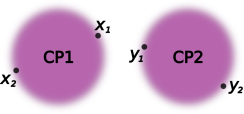
Figure 22. Schematic. See text. Nuclei repel one another. Therefore, because the points $x_1$ and $y_1$ shown in Fig. 22 are relatively close to one another, it seems reasonable to expect that the probability density of there being a nucleus at $x_1$ would be reduced by Coulomb repulsion if there was a nucleus at $y_1$. If that was the case, ${\dencpp{1}(x_1|y_1)}$ would be less than ${\denargp{1}(x_1)}$, so ${\ddencpp{1}(x_1|y_1)}$ be negative, and the contribution of points $x_1$ and $y_1$ to ${\Edynarg{++}}$ would be negative.
On the other hand, ${\ddencpp{1}(x_2|y_2)}$ might be positive, despite the repulsion that would exist between nuclei at $x_2$ and $y_2$, because probability density is conserved and because the distance between $y_2$ and $x_2$ is larger than the distance between ${y_2}$ and most other points in CP1. Since the electric potential from a nucleus at $y_2$ would be lower at $x_2$ than at most other points in CP1, the presence of a nucleus at $y_2$ might increase the nucleus number density at $x_2$ in order to reduce it elsewhere.
Overall, however, if nuclei were sufficiently mobile, and if other contributions to the correlation energy (${\Edynarg{--}}$, ${\Edynarg{+-}}$, and ${\Edynarg{-+}}$) had negligible effects on the dynamics of nuclei, points in CP1 that are close to CP2 would be more likely to contribute negatively to $\Edynarg{++}$, and points in CP1 that are further away from CP2 would be more likely to contribute positively to ${\Edynarg{++}}$.
Then ${\edynarg{++}(x_1)}$ is likely to be negative and ${\edynarg{++}(x_2)}$ is likely to be positive. Furthermore, since $x_1$ is closer to CP2 than $x_2$ is, it is likely that
Therefore ${\Edynarg{++}}$ is more likely to be negative than positive. Similar reasoning could be used to argue that ${\Edynarg{--}}$, ${\Edynarg{+-}}$, and ${\Edynarg{-+}}$ are all likely to be negative; and it is known that the sum ${\Edyn}$ of all contributions to the correlation energy is negative.
However, while arguing that $\Edynarg{++}$ is likely to be negative, we have implicitly made some physical assumptions that are not necessarily justified or valid, or even likely to be justified or valid. For example, we have assumed that ${\Edynarg{++}}$ is not changed significantly by correlations between electrons and nuclei. However, we will not discuss this possibility because we will discuss another of our implicit assumptions, which but we will discuss another of our implicit assumptions. Its dubious validity that we have made, and which makes that assumption likely to be valid.
At first sight, and as it is presented above, the reasoning appears to contain a strong and unjustified implicit assumption. Namely, it appears that the fact that one of CP2’s nuclei is at $y$ at time $\tau$ changes the probability density at time $\tau$ that one of CP1’s nuclei is at $x$. If this assumption was being made, it would not be valid because the time taken by nuclei in a neighbourhood of $x$ to respond to the arrival of a nucleus at $y$ is finite. Their response is not instantaneous.
However, let us not forget that ${\Edynarg{++}}$ can be expressed as ${Z^2\bbraket{\dencpp{1}}{\denargp{2}}}$ or as ${Z^2\bbraket{\denargp{1}}{\dencpp{2}}}$, and that the correlation is not the nuclei of CP1 responding to fluctuations in the spatial distribution of CP2’s nuclei, or vice-versa, but the nuclei of each CP moving under the influence of the other CP’s nuclei. The motions of the nuclei and electrons of CP1 are correlated with one another and, to a lesser degree because they are further away, they are correlated with the motions of CP2’s nuclei and electrons.
Therefore it is not appropriate to interpret ${\ddencpp{1}(x|y)}$ as the response of CP1’s number density of nuclei at $x$, ${\denargp{1}(x)}$, to one of CP2’s nuclei suddenly appearing at $y$; and it is not even appropriate to interpret it as a response to the entire history of the nucleus whose position at time $t$ is $y$. It should be interpreted as an average of the responses to the trajectories in the set
We have found the following expression for the total energy of CP1+CP2, which is exact in the limit of zero overlap between CP1 and CP2 if CP1+CP2 is in a pure state $\Psi$.
Let us assume that an isolated C-particle is approximately spherical but thermally disordered. When two C-particles approach one another the interaction between them can break their near-spherical symmetry. If they are observed on a time scale that is short relative to the time scale on which they rotate about an axis passing through their centers, and that is short relative to the time scale on which the internal structure of a C-particle can rearrange, it is reasonable to assume that they are observed in a pure state. This is because there are no relevant symmetries on such a time scale.
Let us now consider the different types of correlation described by the $\delta\bar{v}$ terms on the right hand side of Eq. (189). The terms $-Z\expval{\pdensuper{1}_\p,\delta\bar{v}_\p^{(2)}}$ and $-Z\expval{\pdensuper{2},\delta\bar{v}_\p^{(1)}}$ account for the energy associated with synchronicity between the motion of nuclei on one C-particle and the motion of nuclei and electrons on the other. If we assume that nuclei move much more slowly that electrons and that electrons are free to move so that, on the time scale of nuclear motion, they perfectly screen any fields from nuclei on the other C-particle, then $\delta\bar{v}_\p{(1)}=\delta\bar{v}_\p{(2)}=0$ and only the synchronous motion of electrons on different C-particles is relevant. Our assumption that electrons move freely also implies that $\Eintmf[\pdensuper{1},\pdensuper{2}] =0$, since both C-particles are globally charge-neutral and since on nuclear time scales electrons move rapidly to ensure local charge-neutrality. Therefore, it is expected that a very good approximation to the energy of CP1+CP2 is provided by
\begin{align*}
E & \approx \sum_\alpha\lambda_\alpha\left(\Epsilon^\alpha_1+\Epsilon^\alpha_2\right)
+\frac{1}{2}
\expval{\pden_\subminus^{(1)},\delta\bar{v}_\subminus^{(2)}}
+\frac{1}{2}\expval{\pden_\subminus^{(2)},\delta\bar{v}_\subminus^{(1)}},
\end{align*}
I.5.11 Appendix to Appendix (I):Creation and annihilation operators
Note that ${\Wn_\beta}$, where ${\beta\neq\alpha}$, depends indirectly on ${\ket{\varphi_\alpha}}$, and this dependence could be made explicit, but I will not do this. However, I will draw out the dependence of ${\Delta\varepsilon_{\alpha\beta}}$ on orbitals other than ${\ket{\varphi_\alpha}}$ and ${\ket{\varphi_\beta}}$. These dependences enter ${\Delta\varepsilon_{\alpha\beta}}$ via $\hat{\mathcal{V}}_{\alpha\beta}$, because ${\ket{\Theta_\alpha}}$ and ${\ket{\Theta_\beta}}$ both contain finite overlaps with at least${N-1}$ natural $1$-states.
The overlap of ${\ket{\Theta_\alpha}}$ with ${\ket{\varphi_\alpha}}$ vanishes by Eq. (164); however ${\braket{\varphi_\alpha}{\Theta_\beta}}$ does not vanish, in general, if ${\beta\neq\alpha}$. Therefore, let us express ${\ket{\Theta_\beta}}$ as the sum of a state with finite overlap with ${\ket{\varphi_\alpha}}$ and a state $\ket{\Theta_{\beta\perp\alpha}}$ whose projection onto ${\ket{\varphi_\alpha}}$ vanishes. To facilitate this decomposition, let us define the annihilation operator ${\hat{a}_\alpha}$ and the creation operator${\hat{a}_\alpha^\dagger}$ by their actions on an $M$-particle state $\chi_M$ and an $(M-1)$-particle state $\chi_{M-1}$, respectively.
where ${\hat{\mathcal{A}}}$ is the antisymmetrization operator. With a bit of algebra it can be shown that ${\hat{a}_\alpha\hat{a}_\alpha^\dagger + \hat{a}_\alpha^\dagger\hat{a}_\alpha=\identity}$, where $\identity$ is the identity. Note that this notation is a bit sloppy and, as a result, this expression for the identity is misleading. We should really express it as ${\hat{a}_{M+1,\alpha}\hat{a}_{M+1,\alpha}^\dagger + \hat{a}_{M,\alpha}^\dagger\hat{a}_{M,\alpha}=\identity_M}$, where ${\hat{a}_{M,\alpha}}$ acts on $M$-particle states to produce ${(M-1)}$-particle states, ${\hat{a}_{M,\alpha}^\dagger}$ acts on $(M-1)$-particle states to produce ${M}$-particle states, and ${\identity_M}$ is the identity in the $M$-particle Hilbert space. With this in mind, let us proceed with the simpler sloppy notation. We can write
where ${\ket{\theta_{\alpha\beta}}\equiv \braket{\Theta_{\beta-\alpha}}{\Theta_\alpha}}$ is a $1$-particle state that is orthogonal to $\ket{\varphi_\alpha}$ and, to reach the second equation from the first, I have used the orthogonality of ${\Theta_\alpha}$ to ${\varphi_\alpha}$, as follows: in the expression for ${\hat{a}_\alpha^\dagger\Theta_{\beta-\alpha}}$, I expanded the antisymmetrized product of ${\Theta_{\beta-\alpha}}$ and ${\varphi_\alpha}$ as a sum; then I used the fact that each integral for which the argument of ${\varphi_\alpha}$ is not $2$ vanishes.
Comments