6. Demands of symmetry and asymmetry
https://doi.org/10.48550/arXiv.2403.13981
In this section I discuss some properties that we should expect a macrostructure to have, on symmetry grounds, if it is a spatial average of a microstructure.
I begin, in Sec. 6.1, by discussing consequences of the linearity of the spatial averaging operation, ${\nu\mapsto\expval{\nu;\mu}_\epsilon}$. I discuss consequences of the fact that linear spatial averaging operations commute with derivatives in Sec. 6.2. In Sec. 6.3 I point out that the symmetry of an object or material depends on the scale at which is described, and that this observation has some important consequences. I discuss general properties of macroscopic vector fields in Sec. 6.5; and I discuss the macroscopic potential $\bphi$, the macroscopic polarization $\pp$, and the polarization current ${\Jconv}$ in Sec. 6.6, Sec. 6.7, and Sec. 6.8, respectively.
6.1 Linearity and the superposition principle
Let ${\hat{\mathcal{E}}_\rho}$ be a functional such that if $\rho$ is a microscopic charge density, ${\hat{\mathcal{E}}_\rho[\rho]}$ is the microscopic electric field emanating from it. It is well known that if $\rho_1$ and $\rho_2$ are any two microscopic charge densities, then the relationIn the context of electricity, the principle of linear superposition, or simply the superposition principle, are well known. They express the fact that derivatives and integrals are linear operations and the fact that ${\me=-\grad\phi}$ and ${\rho/\varepsilon_0\equiv\div\me=-\laplacian\phi}$ are both negative derivatives of ${\phi}$.
A one dimensional spatial average has the general form
6.2 Spatial averaging commutes with derivatives
It can be shown from Eq. (7) that spatial averages and derivatives commute. For example,6.2.1 Relationships between ${\bphi}$, ${\E}$, and ${\Rho}$
Since spatial averaging commutes with derivatives, it would follow from defining macroscopic fields as spatial averages of their microscopic counterparts that the relationships between $\bphi$, $\E$, and $\Rho$ are the same as those between $\phi$, $\me$, and $\rho$. In other words, it would imply that ${\E=-\grad\bphi}$ and ${\Rho = -\varepsilon_0\laplacian\bphi=\varepsilon_0\div\E}$.In Sec. 8 we will identify ${\bphi}$, $\E$, and $\Rho$ with spatial averages of ${\phi}$, $\me$, and $\rho$, respectively, but we will see that their definitions are a bit more complicated than, for example, ${\bphi\equiv\expval{\phi;\mu}_\epsilon}$ for some averaging kernel $\mu$ and some width parameter $\epsilon$. Nevertheless, they are spatial averages and the homogenization transformation is linear, which means that the macroscopic counterpart of the derivative ${\dnu{1}}$ of $\nu$ is the derivative ${\dNu{1}}$ of the macroscopic counterpart $\Nu$ of $\nu$.
Therefore homogenization does not create new fields, $\pp$ and $\D$, as it does in Maxwell’s theory; and the linearity of the homogenization transformation implies that calculating $\bphi$ and $\E$ from $\Rho$ must be equivalent to first calculating $\phi$ and $\me$ from $\rho$ and then spatially averaging them to find $\bphi$ and $\E$, respectively.
6.3 Symmetry is scale-dependent
It seems obvious that symmetry is scale-dependent. For example, a ball bearing that has been manufactured with precision can appear perfectly spherical on the macroscale. However, if it is examined at a sufficiently high magnification, surface texture that breaks its spherical symmetry can be observed.As well as seeming obvious, the scale-dependence of symmetry appears to follow from the fact that derivatives and spatial averaging commute. For example, a crystal with microstructure ${\rho_\text{crystal}}$ and a glass with microstructure ${\rho_\text{glass}}$ can have exactly the same bulk macrostructure ${\Rho}$; and they usually do because ${\Rho=0}$ in the bulk of any stable electromagnetically-isolated material whose surfaces are not charged.
The superposition principle implies that the macroscopic field emanating from the bulk of the crystal can be expressed as
It follows that neither a crystal’s symmetry, nor any other characteristic of its microstructure that differs from the glass, alters the macroscopic electric field or the macroscopic electric potential emanating from its bulk. The only symmetries that manifest at the macroscale are symmetries of the macrostructure.
6.4 Nonlinear relationships and response functions
It is important to note that the superposition principle applies only to linear physical systems. A more accurate way to state this is that a linear physical system is defined as a system in which the superposition principle applies.The superposition principle could not apply to all of the quantities ${\alpha(x)}$, ${\beta(x)}$ and ${\gamma(x)}$ if they were related by ${\alpha(x) = \beta(x)\gamma(x)}$, because $\beta$ and $\gamma$ are not linearly related. For example, if ${\alpha=\alpha_1+\alpha_2}$ where ${\alpha_1=\beta_1\gamma_1}$ and ${\alpha_2=\beta_2\gamma_2}$, then
For example, if $\DRho$ is a material’s macroscopic response to an arbitrarily-weak applied field $\Eext$; and if the change $\Dbsigma$ in the material’s surface charge is the integral of ${\DRho}$ across the surface; then ${\Dbsigma\propto \Eext}$. However, the constant of proportionality does not have an analogue at the microscale to which it can be related by spatial averaging.
In fact, because the material is macroscopically uniform at equilibrium before and after ${\Eext}$ is switched on, ${\Rho}$ vanishes in the bulk both with and without ${\Eext}$. Therefore the macroscopic response to $\Eext$ is not a response of the bulk, but a change of the excesses of charge at surfaces and interfaces. At the microscale, by contrast, the response of the material’s equilibrium microstructure to $\Eext$ is a change of the charge density at surfaces, interfaces, and at all points in the bulk.
6.4.1 ``The interface is the device'' [Kroemer, 2001]
The electrical macrostructure of the bulk of a material is indistinguishable from vacuum; and the macroscale response of a material to a uniform field manifests only at surfaces and other macroscopic heterogeneities. Therefore it may be better to view a macroscopic response function, such as a conductivity or permittivity, as a property of a pair of surfaces instead of as a property of the material occupying the space between them.For example, if ${\bsigma_1}$ and ${\bsigma_2}$ are the areal charge densities of two opposing parallel surfaces, a macroscopic response function ${\bchi_{12}(\bsigma_1,\bsigma_2,\bsigmadot_1,\bsigmadot_2,\cdots)}$ might describe the rate of change ${\bsigmadot_1 = -\bsigmadot_2}$ when a field is switched on, the rate of energy dissipation during this change, etc.. The composition and microstructure of the material’s bulk would help to determine $\bchi_{12}$, but so would the microstructures and compositions of both surfaces.
In other words, it is not that bulk properties do not help to determine properties of surfaces and interfaces. The Born effective charges [Gonze and Lee, 1997; Ghosez et al., 1998; Born and Huang, 1954] of an insulator’s sublattices certainly help to determine how much charge its surfaces exchange when a uniform field is applied to it. However ${\Rho}$ vanishes in the bulk beforehand and afterwards, so if the response is a change of macrostructure, the responders are surfaces and interfaces. This difference in emphasis and perspective seems important.
6.5 Macroscopic vector fields
As discussed in Sec. 6.3, and as Fig. 1 illustrates, symmetry is scale-dependent: A material whose microstructure $\rho$ is highly inhomogeneous and anisotropic can have a bulk macrostructure with local continuous translational symmetry,which implies local isotropy,
As noted in Sec. 6.3, the material cannot be stable unless its bulk is charge-neutral on average, i.e., ${\Rho=0}$. Therefore it is macroscopically uniform and locally isotropic at each point $\mx$. It follows that any observable directionality at $\mx$ must be a consequence of the inequivalence of $\Rho$ at distances larger than ${\bm{u_\text{max}}(\mx)}$ in the two directions. Therefore, a macroscopic vector field whose value at each point is a linear functional of $\Rho$ (or $\rho$) cannot emanate from the bulk of a macroscopically-uniform material, because the bulk macrostructure cannot bestow directionality. This implies that ${\E}$ vanishes and ${\bphi}$ is constant in the bulk.
Similarly, the existence of $\pp$ is attributed to the bulk microstructure lacking inversion symmetry. However, regardless of the microstructure, the bulk macrostructure has inversion symmetry and a macroscopic $\pp$ field seems incompatible with that.
6.5.1 Current density
There is one macroscopic vector field in a uniform material’s bulk that is, in a certain sense at least, retained by the homogenized theory. This is the current density, $\J$. Although $\J$ is not observable in the uniform bulk, its consequences, such as the rates of change of accumulations of charge at macroscopic heterogeneities (surfaces, defects, etc.), are observable.The rate of change of an accumulation of charge at a macroscopic defect or interface can be calculated from ${-\div\J}$ or from the difference $\Delta\J$ in the values of $\J$ on either side of an interface. Therefore, instead of defining $\J$ at each point in the bulk, at the macroscale we need only concern ourselves with $\Delta\J=\bsigmadot$ or ${-\div\J\abs{\dbx}^\dimension=\bqdot}$, which are the rates of change of the excesses of charge at an interface and at a point, respectively, in ${\dimension}$ dimensions.
It is not possible, in general, to deduce the direction of $\J$ from the rate of change of areal charge density $\bsigma$ at an interface. However if, in a closed system, one knows the rates of change of accumulations of charge on every source of macroscopic heterogeneity, one could calculate the magnitude and direction of the current density everywhere in the uniform regions surrounding and separating these heterogeneities. This is the essence of electrical circuit theory.
My argument in this section is that symmetry is scale dependent and that, regardless of a material’s microstructure, no directionality should be observable at the macroscale if the macrostructure is isotropic. $\J$ should not be regarded as either invalidating this argument or as an exception to this principle because $\J$ is not observable at the macroscale. Only its consequences, such as $\bsigmadot$ and the rate of change of temperature ${\mathbf{\dot{T}}}$ are.
6.6 Mean inner potential, $\bphi$
The arguments of the previous section, and the linear relationship between the mean inner potential $\bphi$ and $\rho$ and $\Rho$, imply that $\bphi$ vanishes if a material’s surfaces are not charged. This contradicts a great deal of existing literature, including textbooks and many recent research articles [Bethe, 1928; Miyake, 1940; Sanchez and Ochando, 1985; Wilson et al., 1987; Wilson et al., 1988; Wilson et al., 1989; Pratt, 1992; Gajdardziska-Josifovska et al., 1993; Spence, 1993; Sokhan and Tildesley; Spence, 1999; Leung, 2010; Kathmann et al., 2011; Cendagorta and Ichiye, 2015; Blumenthal et al., 2017; Hörmann et al., 2019; Yesibolati et al., 2020; Madsen et al., 2021; Kathmann, 2021]. However, those works often assume that ${\bphi}$ and the average potential experienced by a particle moving through the bulk are the same quantity, or they approximate the latter as the former.Even if a particle spends a very long time in a material, it does not sample space uniformly. It samples regions of positive electric potential, where the electron density is high, more than regions of negative potential. Furthermore, an electron is a perturbing probe of electric potential. It does not sample a material’s equilibrium microscopic potential ${\phi(\rvec)}$ because its presence at position ${\rvec}$ reduces the probability density of other electrons being in a neighbourhood of ${\rvec}$, which reduces the negative potential it experiences from other electrons.
Therefore if the spatial average of ${\phi}$ is zero, meaning that a non-perturbing probe would measure an average microscopic potential of zero if it sampled the entire space within a material uniformly, the average potential experienced by an electron would be positive. For the same reason, the average potential experienced by a diffusing cation is negative because it attracts electrons to it and repels nuclei and other cations.
The superposition principle helps to understand why ${\bphi}$ vanishes in a material’s bulk (${\implies-\grad\bphi=0}$). It means that the potential emanating from any nucleus is the sum of the potentials emanating from its constituent protons. Therefore the spatial average of the potential inside a charge-neutral material can be expressed as the sum of the spatial averages of the potentials emanating from point particles of charge ${+e}$ (protons) and point particles of charge ${-e}$ (electrons). The spatial average of the potential from an electron is the negative of the spatial average of the potential from a proton. Therefore, since there are equal numbers of protons and electrons in a charge-neutral material, $\bphi$ can be expressed as a sum of vanishing contributions from proton-electron pairs.
6.7 Bulk polarization, $\pp$
In this section I examine some consequences of assuming that $\pp$ can be expressed as some functional $\hat{P}_\rho$ of $\rho$. I do so under the assumption that ${\E\equiv\hat{E}_\rho[\rho]}$ and ${\Rho\equiv\hat{\varrho}_\rho[\rho]}$ are both linear functionals of $\rho$. If they were not linear, either the superposition principle would not apply at the macroscale, or the ${\rho\mapsto\Rho}$ homogenization transformation would not conserve net charge. They are linear if $\E$ and $\Rho$ are spatial averages of $\me$ and $\rho$, respectively.A polarization field is believed to exist in any crystal whose microstructure lacks inversion symmetry. Therefore ${\hat{P}_\rho[\rho]}$ must be a nonlinear functional because the superposition ${\rho = \rho_1+\rho_2}$ of two inversion-symmetric crystal structures does not have inversion symmetry, in general. If ${\hat{P}_\rho[\rho_1]= 0}$, ${\hat{P}_\rho[\rho_2]=0}$, and ${\hat{P}_\rho[\rho]\neq 0}$, then
Let us assume that
Any microscopic charge density $\rho$ can be written as a (possibly infinite) sum of inversion-symmetric charge densities; the Fourier series of a periodic $\rho$ being one example. It follows that ${\pp^l\equiv\hat{P}^l_\rho[\rho]=0}$ for any $\rho$, that the linear part of $\D$ is ${\D^l\equiv\hat{D}_\rho^l[\rho]=\varepsilon_0\E}$, and that its nonlinear part $\D^{nl}$ is simply ${\pp}$.
With these constraints the set of relationships that constitute the macroscale theory of electricity can be expressed as
Let us consider two ways to proceed from here. The first is to follow convention by finding a way to define $\pp$. This would lead to definitions of ${\D}$, ${\Rhobound}$, ${\Rhofree}$, ${\Jbound}$, and ${\Jfree}$, where ${\Jbound\equiv\Jconv}$ and ${\Jfree\equiv\Jcond}$ are currents of bound charge density (${\Rhobound}$) and free charge density (${\Rhofree}$), respectively. I denote them by ${\Jconv}$ and ${\Jcond}$ to avoid distinguishing between free and bound charges. Introducing these six fields to the theory does not make it any more predictive or useful. Furthermore, $\pp$ and $\D$ are not observable; ${\Jfree}$ is only observable when ${\Jbound=0}$ and vice versa; and free charge is only observable where the net bound charge vanishes and vice versa.
A much simpler and less conventional way to proceed is to not introduce any unobservable quantities into the theory, but to find a way to calculate ${\Jconv}$. We do not need to distinguish between different contributions to $\J$ in either Maxwell’s equations or the contintuity equation if we are not distinguishing between $\Rhofree$ and $\Rhobound$. Therefore ${\Jcond+\bdot{\pp}}$ can be replaced by $\J$ with the understanding that ${\J}$ is the net flow of charge from all mechanisms.
We are left with only the four equations above, which are identical in form to their counterparts at the microscale, and in which all three electrical quantities that appear in them ($\Rho$, $\J$, $\E$) are observables with clear and intuitive meanings. There is no downside to scrapping $\pp$ and $\D$ and it circumvents many problems, such as the fact that we do not have a definition of $\pp$, and the fact that, because $\pp$ is nonlinear and $\E$ is linear, ${\pp\neq\varepsilon_0\boldsymbol{\chi}\E}$.
It is important to note that a key premise or conclusion of the Modern Theory of Polarization is that my central premise in this section, namely that $\pp$ can be calculated from $\rho$, is false [Resta and Vanderbilt, 2007]. It is claimed, instead, that $\pp$ is a property of the phase $\theta$ of the material’s wavefunction ${\Psi=\sqrt{\pdf}\,e^{i\theta}}$. I will discuss this claim in Sec. 7 and Sec. 13.
6.8 Polarization current as a demand of anisotropy
Fig. 2 shows several stages in the evolution of the equilibrium charge density $\rho$ in the bulks of three crystals as some stimulus $\zeta$ is applied uniformly to them. The stimulus might be a change in temperature, a strain, a displacement of one of the crystal’s sublattices relative to the others, or anything else that changes a crystal’s charge density uniformly throughout the bulk.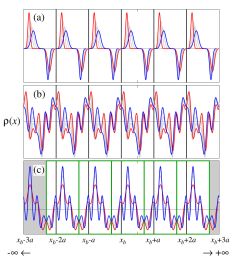
The charge density in Fig. 2 (c) has inversion symmetry, with two centers of inversion in each primitive unit cell; and it maintains this inversion symmetry as $\zeta$ changes and ${\rho(x;\zeta)}$ evolves. Clearly, the motion of charge relative to one of its centers of inversion must be the same in the ${-\hat{x}}$ and ${+\hat{x}}$ directions. Therefore the existence of a net current is prohibited by symmetry.
On the other hand, the only symmetries possessed by the charge densities in Fig. 2(a) and Fig. 2(b) are their periodicities. Therefore it is impossible for the motion of charge in the ${-\hat{x}}$ and ${+\hat{x}}$ directions to be equitable, because those directions are inequivalent and two numbers within the same continuous range cannot be exactly equal, meaning equal to infinite precision, by chance. If they are equal, it is by reason of symmetry; and if symmetry does not demand that they are equal, the probability of them turning out to be equal to $M$ significant figures vanishes in the ${M\to\infty}$ limit.
To tighten this argument let us assume that each of the three charge densities in Fig. 2 can be expressed as a sum ${\rho(\zeta)=\rhop(\zeta)+\rhom(\zeta)}$ of the non-negative charge density of the nuclei ($\rhop$) and the non-positive charge density of the electrons ($\rhom$). Let $C$ denote the center of electron charge of the six unit cell segment shown in Fig. 2(b); and let ${\dot{c}(x_b)\equiv\mathrm{d}c(x_b)/\mathrm{d}t}$ be the rate of change of the center of charge of the $\Neleccell-$electron charge density in unit cell ${\unitcell\equiv(x_b,x_b+a)}$. There is no symmetry reason to expect ${\dot{c}(x_b)}$ to vanish; therefore it does not.
The rate of change ${\dot{C}\equiv\mathrm{d}C/\mathrm{d}t}$ of $C$ is the average of the rates of change of the centers of charge of the six unit cells. Since the cells are identical, ${\dot{C}}$ is also equal to ${\dot{c}(x_b)}$; and the current per unit length associated with this motion of electrons is ${-\Neleccell\,e\,\dot{c}(x_b)/a}$. To find the total current density the contribution from nuclei should be added to it.
Now let us turn to the material in Fig. 2 (c). However, instead of expressing ${\dot{C}}$ as the average value of ${\dot{c}}$ for the six complete cells delimited by vertical black lines, let us express it as the average value of ${\dot{c}}$ for the five complete green-bordered cells and the remaining cell, which is shaded in grey and divided into two pieces on either side of the five.
The centers of charge of the green cells are time-invariant, by symmetry. Therefore ${\dot{C}=\dot{c}_g/6}$, where ${c_g}$ denotes the center of electron charge of the grey cell. Now suppose that the number of primitive cells in the segment was not six, but of order ${l/a}$, such that the segment was mesoscopic. Then the rate of change of its center of electron charge, and therefore the current, would be ${\dot{C} \sim (a/l)\,\dot{c}_g}$, which is negligible.
6.8.1 Anistropy introduced by the stimulus
Just as a polarization current flows when a material without inversion symmetry is uniformly stimulated, it also flows when the crystal has inversion symmetry, but the stimulus that changes $\rho$ breaks this symmetry. This is the case when, for example, the stimulus is an applied electric field or a non-uniform strain (flexoelectricity).Crystals can be categorized based on what sorts of stimuli are capable of causing these transient polarization currents. An electric field induces a polarization current in any crystal, whereas only crystals that lack inversion symmetry tend to be pyroelectric, because temperature does not reduce crystals’ symmetries, in general, so they remain inversion symmetric as they are heated. A larger set of crystal symmetries are compatible with piezoelectricity because uniform uniaxial strain can break inversion symmetry.
Comments