8. Macrostructure as homogenized microstructure
https://doi.org/10.48550/arXiv.2403.13981
8.1 Introduction
In this section I present elements of a classical theory of structure homogenization, meaning a theory of how microstructures determine macrostructures, and of the resulting natures of macrostructures. In later sections I will use this theory to elucidate the relationships between the microscopic fields $\phi$, ${\me}$, and ${\rho}$ and their macroscopic counterparts $\bphi$, $\E$, and $\Rho$.The most obvious and intuitive approach to deriving electromagnetic theory at the macroscale from Maxwell’s vacuum theory is to define macroscopic fields as spatial averages of their microscopic counterparts. However, despite this having been tried many times and in many ways [Rosenfeld, 1965; Kaufman, 1961; de Groot and Vlieger, 1965; Schram, 1960; de Groot and Vlieger, 1964; Mazur and Nijboer, 1953; Mazur, 1957; Robinson, 1971; Russakoff, 1970; Jackson, 1998; Ashcroft and Mermin, 1976; Kirkwood, 1936; van Vleck, 1937; Kirkwood, 1940; Bethe, 1928; Miyake, 1940; Wilson et al., 1987; Vinogradov and Aivazyan, 1999; Kamenetskii, 1998], we lack a fundamental understanding of the relationship between microstructure and macrostructure.
There are two main reasons why previous attempts have not succeeded, or have not succeeded fully. The first is that more fields appear in Maxwell’s macroscopic theory than appear in his vacuum theory. Therefore, for example, the fields $\pp$ and $\D$ cannot be defined as spatial averages of their counterparts at the microscale because they do not have counterparts at the microscale.
The second reason is that, to define one field as the spatial average of another, it is necessary to introduce one or more parameters specifying the size and shape of the region of space that is averaged over, and the distribution of weights with which points in this region contribute to the average. The dependences of macroscopic fields on these parameters has been interpreted as a fatal flaw in their definitions as spatial averages.
However, this non-uniqueness should not be interpreted as a fatal flaw, but as intrinsic to the nature of macrostructure, which is not determined by microstructure alone. It is determined, in part, by the relationship between the observer and the microstructure: A macroscopic field is a microscopic field observed on a large length scale. What is observed depends on how large that scale is. Therefore any definition of a macroscopic field in terms of its microscopic counterpart must depend on a parameter that specifies it.
In addition to the scale on which the underlying microscopic field is observed, a macroscopic field depends on the perspective from which the microstructure is observed, the apparatus with which it is observed, and the fields that mediate the observation. Therefore, when defining reproducibly-measureable macrostructure it is necessary to choose which of these influences are incorporated into the definition, and which of them are left to observers as apparatus-specific corrections. For simplicity and generality, I will assume that the only parameter on which the definition of macrostructure depends is the smallest distance, $\abs{\dbx}$ across which changes in macroscopic fields are observable at the macroscale. All other observer-specific influences are left as corrections to be applied when a specific observation is compared to the theory built on this one-parameter definition.
Perhaps unsurprisingly, there is a trade-off between the precisions to which gradients of macroscopic fields are defined and the spatial precision at the macroscale, $\abs{\dbx}$. When the uncertainty in position is small, the uncertainty in the gradient of a macroscopic field is large, and vice-versa, with the product of these uncertainties being proportional to the uncertainty in the value of the macroscopic field itself. This uncertainty principle is derived in Sec. 8.9, but I begin discussing its consequences for the nature of macrostructure in Sec. 8.3, so that readers understand why defining a macroscopic field in terms of its microscopic counterpart is only one of two primary objectives of this structure homogenization theory. An equally important objective, which is arguably more important from a practical perspective, is to define macroscopic excess fields, such as surface charge densities, $\bsigma$.
I begin by outlining the simplifying assumptions that I make about the nature of the microstructure.
8.2 Assumed properties of the microstructure, $\nu$
Here, and throughout this work, I will assume that the microstructure only varies significantly on the microscale and on the macroscale, and that the macroscale is many orders of magnitude larger than the microscale. For example, the microscale might be the nanometer scale, and the smallest distance across which variations of macroscopic fields are observed might be ${\abs{\dbx}\sim1\,\text{mm}}$.I will assume that the physical system of interest does not contain any material with a microstructure that varies significantly on intermediate length scales. For example, the microstructure of wood varies on every length scale between ${\sim1\,\text{nm}}$ and the scale (${\sim10\,\text{m}}$) of the tree from which it was harvested [Toumpanaki et al., 2021]. When it is observed on any length scale in this ten order-of-magnitude range, its surface is observed to have texture. Therefore the theory presented herein does not apply to wood. It applies when texture is only observable on the microscale and on the macroscale. The texture observed on the macroscale is caused by excess fields at interfaces between regions with different microstructures, or by changes of the microstructure that occur gradually across macroscopic distances.
For simplicity, I will assume that the microstructure is specified by a single scalar field, ${\nu:\realone^n\to\realone}$, and I will denote its counterpart on the macroscale by $\Nu$. Although the value of $n$ is three, the results derived for the ${n=1}$ case can be applied in three dimensions by defining ${\nu(x)}$ to be the average of a function of ${(x,y,z)}$ on the ${y-z}$ plane at $x$. Therefore, to make discussions of the main physical ideas simpler, in this section I will mainly focus on the one dimensional microstructure ${\nu:\realone\to\realone}$.
I make the following assumption about how observations and measurements occur at the macroscale.
A microstructure $\nu$ may fluctuate, to some degree, on every length scale. However, as discussed above, the theory proposed in this section applies under the assumption that $\nu$ may vary significantly on the macroscale $L$ and on the microscale $a$, which are widely separated, but its variations on any intermediate scale, or mesoscale, $l$ are negligible. Generalizing the theory to microstructures that vary on three or more widely-separated length scales appears straightforward, but generalizing it to microstructures that vary on all length scales does not.
To define the microscale and the macroscale more precisely, I introduce the distances ${\amax}$ and ${\Lmin}$. Roughly-speaking, $\Lmin$ is the largest distance such that nonlinearities in the variation of $\Nu$ across distances less than $\Lmin$ are negligible; and $\amax$ is orders of magnitude smaller than $\Lmin$, but large enough that every interval in the set
These conditions do not define $\amax$ and $\Lmin$ uniquely, but it will not be necessary to define them uniquely. Their primary purpose will be to define a mesoscopic distance ${\abs{\dbx}}$, which is the macroscale infinitesimal, and is much larger than any reasonable choice of $\amax$ and smaller than any reasonable choice of $\Lmin$. At the microscale I will denote ${\abs{\dbx}}$ by $\prectheo$.
I define the microscale, the mesoscale, and the macroscale in terms of $\amax$ and $\Lmin$ as follows:
8.3 The nature of macrostructure
I now outline some important features of macrostructure, which are consequences of finite spatial precision at the macroscale.At the macroscale we observe homogenized microstructure. Under the two simplifying assumptions presented in Sec. 8.2, the macrostructures of the bulks of materials are uniform, except, possibly, for the existence of macroscopic point, line, or locally-planar defects. If there are no such defects, all materials appear uniform (textureless) at the macroscale and we only perceive a difference between the bulks of two materials on either side of an interface via observable properties of their microstructures, such as their colours.
A material’s colour is determined by the microscopic wavelengths of electromagnetic radiation with which its microstructure interacts. Since the wavevectors of this radiation are normal to the plane on which the spatial average that produces the observed macrostructure from the microstructure is performed, we observe the radiation, rather than the averages of its electric and magnetic fields along its axis of propagation, which would vanish.
We have assumed, via Physical Assumption 2, that differences in texture are not observable at the macroscale. Physical Assumption 1 implies that differences in colour are irrelevant to macroscale electricity. For example, colour differences cannot be detected as changes in the distributions of electric potential or charge at the macroscale. Therefore the only observable structure at the macroscale is the network of interfaces separating otherwise-indistinguishable regions of uniformity, and any macroscopic defects within these otherwise-uniform regions. Interfaces and other macroscopic heterogeneities are observable because, and only if, they carry observable excess fields.
8.3.1 Excess fields
At the macroscale, an excess field can be understood from Stokes’ theorem. For example, the net charge within a material $\material$ isStokes’ theorem also holds at the microscale if point charges are treated as singularities and the sets of zero measure in which they reside are omitted from the integrals. However, in that case both integrals in the microscale analogue of Eq. (30) vanish, and we must take a different route to understand surface excesses.
A further complication is that surfaces are ill-defined at the microscale: A surface’s microstructure differs, to some degrees, from the microstructures of both the bulk and the atmosphere or vacuum above the surface. Its difference with respect to the bulk microstructure lessens gradually with increasing depth below the surface, so there does not exist a depth below which the material is bulk-like and above which it is not. Therefore surfaces are ill-defined regions of indeterminate widths at the microscale.
The surface ${\partial \material}$ of material $\material$ that appears in Eq. (30) is well defined because, although the thickness of the surface region is indeterminate at the microscale, it is less than ${\prectheo\equiv\abs{\dbx}}$. Therefore the depths of any two points within it differ by less than ${\prectheo}$, which implies that, at the macroscale, the distance between the atmosphere outside a material and the material’s bulk is $\abs{\dbx}$. Surfaces are well-defined at the macroscale because every curve that crosses the surface exactly once contains exactly one surface point. In other words, locally, surfaces are literally planar at the macroscale.
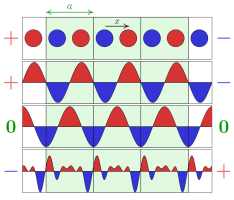
Fig. 4 illustrates, from a microscopic perspective, why surfaces carry excess fields: The average of a microscopic charge density, $\rho$, vanishes in the green-shaded bulk of the one-dimensional materials depicted, but not at points near a surface, in general. For example, consider a point very close to the left-hand edge of one of the unshaded surface regions on the left-hand side. The macroscopic charge density, $\Rho$, vanishes in the green-shaded bulk because the contribution to the spatial average at a point $x$ from all points ${\{x+u:0<u<a/2\}}$ to its right is cancelled exactly by the contribution from all points ${\{x-u:0<u<a/2\}}$ to its left. However, this cancellation cannot happen at a point near the left-most edge of one of the surfaces on the left-hand side, because most of the points to its left are in vacuum, where $\rho$ vanishes.
Therefore, $\Rho$ vanishes in the green-shaded bulk, but does not necessarily vanish in the unshaded surface regions. Since the widths of these regions are much less than ${\prectheo=\abs{\dbx}}$, each one corresponds to a single point at the macroscale. This one-dimensional example illustrates that $\Rho$ vanishes everywhere in the bulk and it vanishes in the vacuum outside the material, but it is finite, in general, at a surface.
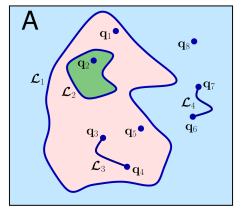
More generally, excess fields describe macroscopically-observable accumulations whose manifestations at the macroscale are best described by distributions whose domains are manifolds of dimension ${n<3}$. For example, the excess of charge on the $i^\text{th}$ surface or interface, which is a two dimensional manifold (or simply 2-manifold), $\manifoldn{2}_i$, is an areal density of charge, ${\bsigma_{i}:\manifoldn{2}_i\to\realone}$; the $j^\text{th}$ linear charge density, ${\linecharge_{j}:\manifoldn{1}_j\to\realone}$, is a charge excess defined on a curve (the 1-manifold, $\manifoldn{1}_j$); and the $k^\text{th}$ macroscopic point charge, ${\pointcharge_k:\manifoldn{0}_k\to\realone}$, is a charge excess defined at a point (the 0-manifold, $\manifoldn{0}_k$). The macrostructure arising from a two-dimensional microscopic charge density is illustrated in Fig. 5.
What this means is that, despite the microstructure being defined by a single field $\nu$, there is more to the macrostructure than the single field ${\Nu}$. The macrostructure comprises $\Nu$, where
We will see that $\Rho$ vanishes in the bulk of any stable material, and that $\bphi$ and $\E$ vanish in a material’s bulk if the material is isolated and its surfaces are charge-neutral. Therefore, defining a material’s electrical macrostructure entails finding a way to define excess fields in terms of the microstructure, $\nu$. Finnis solved this problem for periodic microstructures [Finnis, 1998], such as those plotted in Fig. 4, and I generalize his work to non-periodic microstructures in Sec. 9.
8.4 Assumed properties of $\Nu$
Defining $\Nu$ in terms of $\nu$ is trickier than it first appears, so it is useful to list and discuss the properties that $\Nu$ is assumed to have. There are three of them, which I list below and discuss in Sec. 8.4.1, Sec. 8.4.3, and Sec. 8.4.2.8.4.1 Reproducible measurability of $\Nu$
$\Nu$ is measurable by a blunt probe or as an average of the values of $\nu$ measured by many sharp probes whose locations cannot be controlled or known to microscopic precisions.For example, when you look at a surface, light enters your eye from many closely-spaced points of the surface’s microstructure, but each ray enters at a different angle and with a different intensity and a different frequency, in general. The contributions from all of the rays merge to produce an image of homogenized microstructure in your mind. This is the macrostructure. The merger that homogenizes the microstructure occurs in many stages, involves many different mechanisms, and occurs at many different locations along the path from the surface to your eye to your brain.
When I say that $\Nu$ is reproducibly measurable, I mean that when a particular spatial resolution $\abs{\dbx}$ is chosen, and shared by all repeated measurements, the value of $\Nu$ at each point can be defined independently of any measuring technique or apparatus. This means that, although a measured value of $\Nu$ at a point always contains artefacts of the method used to measure it, if the magnitudes of these artefacts could be made sufficiently small, or if corrections could be applied to remove them, any two measurements of $\Nu$ at the same point would both yield values that were both consistent with the microstructure $\nu$, and with the definition of $\Nu$ in terms of $\nu$.
Despite the complexity of the processes that turn microstructure into macrostructure, I base the homogenization theory presented herein on the following assumption.
8.4.2 Definition of ``fluctuates microscopically''
When I say that ${\nu}$ fluctuates microscopically, or that $\nu$ is a microscopic quantity or a microscopic function, I mean that $\nu$ fluctuates on length scale $a$. This means that every extremum of ${\nu}$ is within a distance ${\amax}$ of another extremum of ${\nu}$. Defining the statements "$\nu$ fluctuates microscopically about ${\valnu}$ at $\bx$" and "$\nu$ fluctuates microscopically about ${\Nu}$ at $\bx$" is more difficult, so I defer discussing them until Sec. 8.8.8.4.3 Macroscale differentiability
The purpose of a macroscopic field theory is to describe changes over macroscopic distances. Therefore if $\Nu$ fluctuated microscopically it would, effectively, be nondifferentiable. For example, if the value of ${\DNu_1\equiv\Nu(\bx+\bh_l +\bh_a)- \Nu(\bx)}$ differed significantly from the value of ${\DNu_2\equiv\Nu(\bx+\bh_l)- \Nu(\bx)}$, when ${\abs{\dbx}<\abs{\bh_l}<\Lmin}$ and ${\abs{\bh_a}<\amax}$, then it would not be possible to approximate ${\Nu(\bx+\bh_l)}$ with a truncated Taylor expansion of ${\Nu}$ about $\bx$ containing few terms.$\Nu$ being differentiable at the macroscale means that, given any point ${\bx\in\dom \Nu}$, the values of ${\left(\Nu(\bx+\bh)-\Nu(\bx)\right)/\bh}$ and ${\left(\Nu(\bx)-\Nu(\bx-\bh)\right)/\bh}$ are equal in the limit ${\abs{\bh}\to\abs{\dbx}}$, to within the precisions to which they are defined.
8.5 Spatial averages
I will define $\Nu$ in terms of (not as) spatial averages of $\nu$ of the formThese properties do not place strong or unphysical constraints on the form of ${\mu(\epsilon)}$, because any function with a well-defined mean and standard deviation can be normalized and translated to give a function whose integral is one and whose mean is zero. That function can be identified as ${\mu(1)}$ and Eq. (31) can be used to define the narrower or wider function ${\mu(u;\epsilon)\equiv \mu(u/\epsilon;1)/\epsilon}$.
The reason for giving $\mu$ a parametric dependence on its width is that it makes it easier to discuss separately the effects on ${\expval{\nu;\mu}_\epsilon}$ of varying the width of ${\mu(\epsilon)}$ and of varying the shape of $\mu(\epsilon)$. For example, it follows from Eq. (31) that the ${n^\text{th}}$ derivative of $\mu$ satisfies
Note that if ${\mu(u;\epsilon)}$ has all of the properties discussed above, then so does the function ${\mu(-u;\epsilon)}$. Therefore the general form of the spatial averages considered in this work may also be expressed as
8.5.1 Schwartz and non-Schwartz averaging kernels
For some averaging kernels, ${\mu(u;\epsilon)}$, there exist values of $m$ such that their rates of decay in the limits ${u\to\pm\infty}$ are slower than ${1/\abs{u}^m}$. Other kernels, such as Gaussians, decay faster than any power law. A smooth function that decays faster than any power law is known as a Schwartz function, so I will refer to kernels of the first and second types as non-Schwartz kernels and Schwartz kernels, respectively.Non-Schwartz kernels tend to describe relatively-direct and physical weightings of microstructures, such as the shape of a blunt probe or the decay of light intensity with distance. Schwartz kernels tend to arise from disorder and uncertainty: They describe limiting cases of homogenizing physical processes, such as the ${N\to\infty}$ limit of the combined effects of $N$ homogenizing influences, each of which can be described by non-Schwartz kernels.
For example, the central limit theorem demonstrates how a Gaussian distribution arises from a very large number of contributions from independent random variables whose distributions do not necessarily decay faster than a power law (see, for example, [Riley et al., 2006], Chapter 30).
Non-Schwartz kernels make it easier to illustrate the complications that arise from defining macroscopic fields as spatial averages of their microscopic counterparts, and top-hat kernels are among the simplest of non-Schwartz kernels. Therefore I will introduce top-hat kernels in Sec. 8.5.2 and use them to illustrate an important consequence of Eq. (32); namely, the fact that ${\expval{\nu;\mu}_\epsilon}$ depends less and less on the shape of $\mu$ as $\epsilon$ increases. Then, in Sec. 8.6, I will use top-hat kernels to illustrate why precision is finite at the macroscale.
8.5.2 Top-hat kernels
A very simple non-Schwartz kernel is the top-hat function,I will refer to the average with a top-hat kernel as a simple spatial average, I will denote it by ${\expval{\nu}_\epsilon (x)}$, and although I will express it as
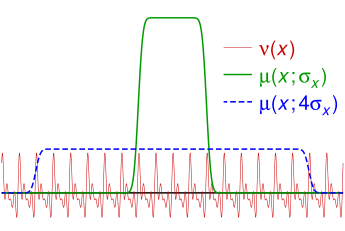
Fig. 6 depicts a periodic microstructure and two differentiable top-hat averaging kernels that might be used to find its spatial average. One of the kernels is four times the width of the other, but both are almost constant almost everywhere: their derivatives are only finite near where they decay to zero.
The wider kernel averages four times more periods of the microstructure than the narrower kernel, but the weighting it applies to each one is smaller by a factor of four. Therefore, any difference between the averages calculated with the two kernels is a result of them applying different non-uniform weights to points near where they decay to zero.
As ${\epsilon}$ increases, the contribution to the average of points where the derivative ${\mu^{(1)}(\epsilon)}$ is non-negligible becomes smaller relative to the contribution from points where ${\mu^{(1)}(\epsilon)}$ almost vanishes. This illustrates the fact that the average magnitudes of derivatives of $\mu(\epsilon)$ decay faster as $\epsilon$ increases than the average of $\mu(\epsilon)$ does (Eq. (32)). Therefore it illustrates the fact that the shape of $\mu$ becomes increasingly irrelevant to the value of ${\expval{\nu;\mu}_\epsilon(x)}$ as ${\epsilon}$ increases.
In much of what follows I will assume that $\epsilon$ is large enough that the shape of $\mu$ is irrelevant and, for simplicity, I will only consider simple spatial averages.
8.6 Why ${\Nu\equiv\expval{\nu}_\epsilon}$ fails as a definition
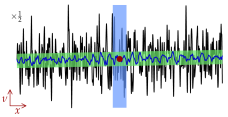
Now let us assume that ${\Nu(x)\equiv\expval{\nu}_\epsilon(x)}$, for some finite value of $\epsilon$, so that the reasons why this definition fails become clear.
One reason why it fails is that two points $x_1$ and $x_2$, which are separated by a microscopic distance ${\abs{x_1-x_2}<\amax}$, would be indistinguishable at the macroscale. Measurements of ${\Nu(x_1)}$ and ${\Nu(x_2)}$ would differ, despite appearing to have been performed at the same macroscale point. Therefore $\Nu$ is not reproducibly-measureable at the macroscale.
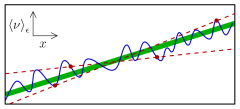
Another reason why it fails is that the finite difference derivative ${\left(\Nu(x+h)-\Nu(x)\right)/h}$ depends sensitively on $x$ and $h$ and fluctuates microscopically as a function of each one, as illustrated in Fig. 8. Therefore $\Nu$ is not differentiable at the macroscale, because its derivative does not converge with respect to $h$ while $h$ is still macroscopic or mesoscopic. It does not converge until $h$ is much smaller than the microscopic distances between successive extrema of ${\Nu}$.
Both of these problems can be resolved by defining ${\Nu(\bx)}$ to be the set of all values that would be measured at the same macroscale point, $\bx$. This is a set of all spatial averages of ${\nu}$ centered at points in an interval whose width is the lower bound, ${\prectheo=\abs{\dbx}}$ on distances that are observable at the macroscale.
Since $\abs{\dbx}$ is the limit of spatial precision at the macroscale, the most precise measurements of $\Nu$ are either performed with microscopically-blunt probes (radii ${\gtrsim \prectheo}$), or with sharper probes whose positions can only be controlled or known to within an interval of width ${\prectheo}$.
Therefore if $\prectheo$ is large enough that ${\expval{\nu;\mu}_\prectheo}$ is independent of the shape of $\mu$, the set of all measured values of ${\Nu(\bx)}$ is the set of values of ${\expval{\nu}_\prectheo(x)}$ at microscale points $x$ that are within an interval of width $\abs{\dbx}$ centered at $\bx$. This set is an interval, ${\interval(\bbNu(\bx),\precNu(\bx))}$. Therefore ${\Nu(\bx)}$ is only defined to a precision, $\precNu(\bx)$, that is finite.
8.7 The macroscale infinitesimal, $\abs{\dbx}$
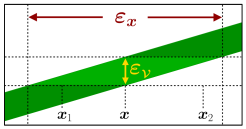
Fig. 9 illustrates why measurements of $\Nu$ cannot conclusively distinguish between $\bx_1$ and $\bx_2$ if ${\abs{\bx_1-\bx_2}< \precNu/\abs{\dNu{1}}}$. In Sec. 8.9 I will present a discussion, for an arbitrary choice of the averaging kernel $\mu$, of the relationship between $\prectheo$, $\precNu$, and the precision $\precmom$ to which the derivative ${\dNu{1}}$ of $\Nu$ is defined.
The macroscale infinitesimal ${\abs{\dbx}}$ is the smallest distance between empirically-distinguishable points, i.e.,
At the microscale, ${\abs{x_1-x_2}<\prectheo/2=\abs{\dbx}/2}$ does not imply that ${x_1=x_2}$. Therefore each point $\bx$ at the macroscale corresponds to an interval of width $\prectheo$ at the microscale. I denote the midpoint of this interval by ${\barx(\bx)}$ and I refer to the interval as the coincidence set of ${\barx(\bx)}$. Mathematically, it is defined as
The one-to-many relationship between points at the macroscale and points at the microscale has important implications for the nature of macrostructure, which have already been discussed in Sec. 8.3. It implies that the transition from the microscale to the macroscale can be viewed as a compression of space, which shrinks all microscopic distances to zero, resulting in surfaces and interfaces becoming literally planar, locally.
8.8 Mutually-consistent values of $\precNu$ and $\prectheo$
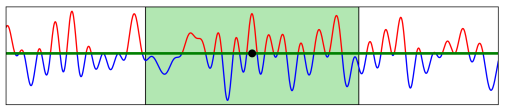
As discussed in Sec. 8.6, the set of all possible accurately- and precisely-measured values of ${\Nu(\bx)}$ is
Furthermore, we must take care to satisfy the requirement that $\nu$ fluctuates microscopically about ${\Nu(\bx)}$ at $\bx$. If we choose an arbitrary mesoscopic value of $\prectheo$, and then use Eq. (35) as the definition of the set of values about which ${\nu}$ fluctuates microscopically at $\bx$, this requirement may not be satisfied. For example, as Fig. 9 illustrates, if ${\abs{\dNu{1}}}$ is large enough, the sets
To remedy this problem we should define this phrase without referring to $\prectheo$, and then choose $\prectheo$ such that $\Nu(\bx)$, as defined by Eq. (35), is a subset of the set of values about which $\nu$ fluctuates microscopically at every ${x\in\coincidence{\barx(\bx)}}$.
I now propose possible definitions of the phrases ‘fluctuates microscopically about $\upsilon$ at $x$’ and ‘fluctuates microscopically about $\upsilon$ at $\bx$,’ which I have not justified rigorously. I present them to illustrate the difficulties with circular definitions, and because they might be useful as a starting point for the development of rigorously-justified definitions that seamlessly link microstructure to what is measured and observed at the macroscale.
Note that Eq. (35) implies that
The following assumption specifies the domain of validity of the three definitions proposed above.
8.9 Uncertainty principle
I have discussed the case of a simple average, with a top-hat kernel, in some detail. The purpose of this section is to discuss, in more general terms, how the shape and width of the averaging kernel determine unavoidable uncertainties in measured values of ${\Nu}$ and its derivative, ${\dNu{1}}$. By analogy with Eq. (35), the set of values of ${\dNu{1}}$ that could be measured at a point $\bx$ isI will now derive a relationship between ${\precNu}$, $\precmom$, and $\prectheo$. For simplicity I will denote the spatial average, ${\expval{\nu;\mu}_\prectheo}$, simply as ${\expval{\nu}}$, I will denote the average of the average as ${\expval{\expval{\nu}}\equiv\expval{\expval{\nu;\mu}_\prectheo;\mu}_\prectheo}$, etc..
To a first approximation, the uncertainty in the value of ${\dNu{1}}$ can be quantified by the variance of ${\expval{\partial_x\nu}}$. Let us use the fact that spatial derivatives commute with spatial averaging to write
Therefore, to a first approximation, or in the limit of large $\prectheo$, the variance of the slope of $\Nu$ is
These relations imply that there is a trade-off between macroscale spatial precision and the uncertainty in ${\dNu{1}}$. When microscopic fluctuations of $\nu$ are large, ${\precNu=2\stdNu}$ is large, and ${\prectheo\precmom=4\sigma_x\sigma_p}$ is large.
8.10 Summary of the fundaments of homogenization theory
In this section I have discussed some of the fundamental features of the homogenization transformation that turns microstructure into macrostructure. I have pointed out that macrostructure cannot be defined uniquely, because it depends on the scale, ${\prectheo=\abs{\dbx}}$, at which the microstructure is observed, and which defines the smallest distance, ${\abs{\dbx}/2}$, between mutually-distinguishable points at the macroscale.However the value of $\abs{\dbx}$ cannot be chosen to be arbitrarily small if distances and displacements are measured with macroscopic fields. This is because $\prectheo$ both determines, and is bounded from below by, the finite precisions, $\precNu$ and $\precmom$, to which macroscopic fields and their derivatives, respectively, are defined. Therefore $\prectheo$, $\precNu$, and $\precmom$ are all interrelated, and can be interpreted either as unavoidably-finite precisions or as measures of unavoidable uncertainty. In Sec. 8.9 I derived uncertainty relations which imply that reducing $\prectheo$ increases the uncertainty $\precmom$ in derivatives of the macroscopic field used to measure distances and displacements.
I have not presented a rigorously-justified relationship between $\prectheo$ and $\precNu$, for an arbitrary microstructure, $\nu$, which satisfies my physical assumptions. In part, this is because any such definition would have to be accompanied by further physical assumptions, which specified more precisely the set of microstructures to which it would apply. However, I have highlighted some of the difficulties that must be overcome to devise rigorously-justified definitions, and I have proposed a definition that I have found to be viable for a useful subset of microstructures that satisfy my physical assumptions. I will present these numerical and theoretical findings elsewhere.
The domain of validity of my proposed definitions is not relevant to the two most fundamental conclusions of Sec. 8. The first of these is that homogenization introduces unavoidable uncertainty at the macroscale, making spatial precision, and the precisions to which macroscopic fields are defined, finite. The second is that finite spatial precision has important implications for the nature of macrostructure, which I discussed in Sec. 8.3, and will discuss further in Sec. 9.
Briefly, it means that surfaces and interfaces, which do not exist in a well-defined sense at the microscale, are created by the homogenization transformation. When they are created they carry excess fields, in general, and these fields are an integral component of macrostructure. In fact, because the macroscopic charge density $\Rho$ vanishes in the bulks of stable materials, in the context of electricity it can be the case that the excess fields, and the 2-, 1-, and 0-manifolds they inhabit, are the macrostructure.
Therefore the task of laying foundations for a homogenization theory that defines macrostructure in terms of microstructure, $\nu$, is far from complete. Completing the foundations entails defining excess fields in terms of $\nu$. This is the subject of Sec. 9.
It is straightforward to generalize the theory presented in this section to systems in which the microstructure varies significantly on three or more widely-separated length scales. In that case homogenization proceeds in stages from the base microstructure, on the smallest length scale, to the apex macrostructure, on the largest length scale. The base microstructure is the only microstructure that is not also a macrostructure determined by a microstructure on a smaller length scale, and the apex macrostructure is the only macrostructure that is not also a microstructure which determines a macrostructure on a larger length scale.
It may not be straightforward to adapt the theory presented in this section to materials whose structures vary significantly on every length scale, such as wood [Toumpanaki et al., 2021]. However, such an adaptation may not be useful because, unlike most artificial materials, wood does not appear to be locally homogeneous when observed with either the naked eye or a microscope at any level of magnification.
Comments