In solid-state physics it is common to use Born-von Kármán (BvK) periodic boundary conditions when studying the bulk of a crystal theoretically [Born and von
Kármán, 1912]. This dispenses with surfaces and is equivalent to placing the bulk of the crystal in a torus. This appendix assembles some of the theoretical infrastructure that is commonly used to simplify theory under BvK boundary conditions. Its main focus is on the mathematical origins and mathematical properties of Bloch functions, and the assumptions under which they enter physical theory.
Bloch functions are single-particle statistical states that are usually introduced in the context of quantum mechanical descriptions of crystals. For example, at the time of writing the Wikipedia page on ‘Bloch’s Theorem’ introduces them as ‘solutions to the Schrödinger equation in a periodic potential’ and uses the example of electrons in a crystal as the context for most of its discussion of them [Wikipedia contributors, 2025]. However it does note their greater generality, and it refers readers to the mathematical field of spectral geometry.
One purpose of this appendix is to emphasize that Bloch functions are not inherently quantum mechanical entities, and do not originate from any particular kind of energetics. Their generality is made clear by introducing them, and deducing their properties, under very loose physical assumptions.
G.1 Physical assumptions
For simplicity I consider a one dimensional crystal whose bulk is represented in a $1$-torus, $\onetorus$, whose circumference is the thickness $\bulksize$ of bulk crystal that occupies it. If $\volume$ is the width of a primitive unit cell of the crystal, ${\bulksize=\Nunitcell\volume}$ for some large positive integer $\Nunitcell$.
The crystal whose bulk is represented in $\onetorus$ consists of a set of particles whose statistical state is ${\volume}$-periodic, in the sense that the particles’ position pdf is invariant under any translation of all of the particles’ positions by the same lattice vector, ${m\volume}$, where $m$ is any integer. The set of particles comprises comprises multiple subsets of identical particles.
We will focus on only one of the crystal’s sets of identical particles. The $\volume$-periodic number density of those particles is
Let us assume that the $\Nident$ particles are not only identical; they are also indistinguishable. They could be electrons, but none of the assumptions made are inconsistent with them being identical billiard balls that are rendered indistinguishable by the very high speeds at which they move: They move too fast for their individual trajectories to be observed. Therefore, because it is impossible to keep track of which particle is which, their position pdf ${\pdf}$ must be exchange symmetric. If $\pdf$ is specified by ${\Psi\in\lebesgue(\onetorus^\Nident)}$, where ${\Psi^*\Psi=\pdf}$, then ${\Psi}$ must be either exchange antisymmetric or exchange symmetric (see Sec. 3.4.1 and Appendix C).
Let us assume that ${n}$ is continuous and has continuous derivatives. The number of derivatives that are required to exist and be continuous is context dependent, but is usually one or two. This is not a stringent requirement given that physical number densities, such as the steady state number densities in a reaction-diffusion system, tend to be smooth.
G.2 A family of `Hamiltonians', $\hamsmallx$
This subsection demonstrates that, for any given $\volume$-periodic number density $n$, any number of operators can be constructed that have all of the properties of the $1$-particle Hamiltonian operator ${\hamsmallx}$ that will be assumed in later subsections of this appendix. The operators introduced in this section are contrived. They are not Hamiltonians, in general. They are introduced simply because their existence demonstrates that, when ${\hamsmallx}$ is used later in this appendix, it does not constitute a non-classical assumption.
G.2.1 A function that specifies the density per particle
where ${\theta:\onetorus\to\realone}$ is a smooth function whose purpose is to ensure that ${\densityfunction}$ is differentiable. It may be necessary because ${\densityfunction}$ may not be differentiable, or may not be practically differentiable, at points where ${n}$ vanishes and its gradient ${\partial_x n}$ does not vanish.
Although physical number densities, such as those at the steady states of reaction-diffusion systems, do not vanish identically, they may become so small that the magnitude of the derivative,
\begin{align*}
\partial_x\densityfunction = \left(\frac{1}{2}\partial_x\log n + i\partial_x\theta\right)
\densityfunction,
\end{align*}
becomes too large for all practical purposes. Therefore $\densityfunction$ may become practically non-differentiable wherever ${n}$ becomes very small, in the following sense:
Let ${\precmicro\in\realpos}$ denote the smallest measurable distance at the microscale. In other words, it is the counterpart at the microscale of ${\prectheo=\abs{\dbx}}$ at the macroscale (see Sec. 8). Then an unequality,
of the left and right finite-difference derivatives would occur wherever ${n}$ becomes very small and its derivative does not vanish more rapidly than ${\sqrt{n}}$.
Wherever this problem arises, $\theta$ is necessary to ensure that, for practical purposes, all required derivatives of ${\densityfunction}$ exist. It can ensure this if it is such that ${\exp(i\theta)}$ changes sign wherever $n$ either vanishes or becomes so small that it would otherwise be practically non-differentiable.
Since $n$ determines where ${\exp(i\theta)}$ changes sign, and since $n$ is $\volume$-periodic, let us assume that ${\exp(i\theta)}$ is also ${\volume}$-periodic. Therefore ${\densityfunction}$ is ${\volume}$-periodic and differentiable.
G.2.2 A family of $1$-particle decompositions of the density
Now let us assume that there exists a complete set of differentiable phase factors which are orthogonal under the density-weighted inner product [Tang, 2006; Iosevich and Liflyand, 2014],
The ${\lebesgue(\onetorus)\to\lebesgue(\onetorus)}$ counterpart of ${\hamsmall:\hilbert\to\hilbert}$ is the integral operator $\hamsmallx$ with kernel ${\hamsmallx(x,x')\equiv \mel{x}{\hamsmall}{x'}}$. Its action on an arbitrary function ${f\in\lebesgue(\onetorus)}$ is
where use has been made of the orthonormality of set ${\densityset}$. Therefore each element ${\psi_\alpha}$ of ${\densityset}$ is an eigenfunction of ${\hamsmallx}$ with eigenvalue ${\epsilon_\alpha}$. It is straightforward to show that ${\hamsmallx}$ is Hermitian.
G.2.3 Energy distribution of occupation numbers
For any choices of the functions ${\occ}$ and ${\epsilon}$, any number of ‘energy distributions’,
can be defined, such that ${\occ_\epsilon(\epsilon_\alpha)=\occ_\alpha,\;\forall \alpha\in\integernonneg}$.
Therefore, given any number density $n$, an infinite number of Hamiltonian operators ${\hamsmallx}$ and energy distributions $\occ$ can be defined such that
G.2.4 A family of $\hilbert$-representations of ${n(x)}$
Let ${\indexsetN}$ denote any subset of ${\integernonneg}$ with exactly ${\Nident}$ elements. Then it is straightforward to show that the ${\Nident}$-dimensional Hilbert space,
is a ${\hilbert}$-representation of the density, $n$; where ${\ket{\psi_\alpha}}$ is the counterpart in the abstract Hilbert space ${\hilbert}$ of ${\psi_\alpha\in\lebesgue(\onetorus)}$.
G.3 Fourier series expansion of an arbitrary eigenfunction, $\varphi$
Let us forget the simplifications and contrivances of Appendix G.2; but let us assume that the $\volume$-periodic number density ${n}$ can be expressed as
where ${\{\varphi_i\}}$ is a complete orthonormal set of eigenfunctions of some $\volume$-periodic operator $\hamsmallx$; and ${\occ_i\in[0,1],\;\forall i}$.
Let ${\varphi}$ be an arbitrary eigenfunction of $\hamsmallx$, with eigenvalue ${\epsilon}$. That is,
Since $\hamsmallx$ is both ${\volume}$-periodic and $\bulksize$-periodic, it will be useful to express the Fourier series expansion of $\varphi$ as the nested sum,
for any ${G\in\reciplatt}$. In words, $\reciplatt$ is not changed by adding the same reciprocal lattice vector $G$ to each of its elements. It follows that, for any choice of ${G\in\reciplatt}$, Eq. (137) can be expressed as
are often referred to as periodic Bloch functions or as cell-periodic Bloch functions [Vanderbilt, 2018]. The latter term avoids confusion between $\bulksize$-periodicity, which the functions ${b(g)}$ and ${u(g)}$ both possess, and ${\volume}$-periodicity, which ${u(g)}$ possesses but which ${b(g)}$ does not possess unless ${g\in\reciplatt}$.
Bloch functions and their periodic counterparts will sometimes be denoted as ${b_g(x)}$ and ${u_g(x)}$ and sometimes as ${b(g,x)}$ and ${u(g,x)}$. These notations can be used interchangably, but when the fact that they are functions of wavevector $g$ is not relevant, $g$ will usually be a subscript.
G.4 Properties of Bloch functions
Since $G$ is an arbitrary element of $\reciplatt$, $\varphi$ can be expressed in the form of Eq. (139) for any choice of ${G\in\reciplatt}$, including ${G=0}$. Therefore,
Since this equation is valid at any point ${x\in\onetorus}$, let us replace $x$ by ${x-m\volume}$ and use the ${\volume}$-periodicities of ${u(G+k)}$, ${u(k)}$ and ${e^{iGx}}$ to express it as
where $m$ could be any integer. If this equation is multiplied by ${e^{-imk'\volume}}$, for any ${k'\in\BZ}$, and summed over all values of $m$ between $0$ and ${\Nunitcell-1}$, the result is
The sum in parentheses vanishes unless ${k=k'}$, in which case its value is ${\Nunitcell}$. Therefore, since $G$ and $k'$ are arbitrary elements of ${\reciplatt}$ and $\BZ$, respectively,
where ${G}$ is an arbitrary reciprocal lattice vector and each Bloch function ${b(k+G)}$ in the sum is associated with a different element $k$ of ${\BZ}$.
Subsection Appendix G.4 has shown that Bloch functions are ${\hreciplatt}$-periodic (${b(G+k)=b(k), \forall G\in\reciplatt,\;\forall k\in\BZ}$) and that each term in the sum satisfies Eq. (145). Therefore, each Bloch function in the sum either vanishes or is itself an eigenfunction of ${\hamsmallx}$ with the same eigenvalue $\epsilon$ as $\varphi$.
G.5 Elements of ${\{b(G+k):k\in\BZ\}}$ are not related by lattice translations
As discussed in Appendix D.4.1, two eigenfunctions of ${\hamsmallx}$ have exactly the same eigenvalue if and only if symmetry demands it. In other words, if two Bloch eigenfunctions share an eigenvalue, they are equivalent to one another by symmetry.
It will now be shown that translating a Bloch eigenfunction by a lattice vector does not change the element of ${\BZ}$ with which it is associated. Therefore the invariance of $\hamsmallx$ under translations by elements of the set ${\volume\integer}$ of lattice vectors would not explain multiple elements of ${\{b(G+k):k\in\BZ\}}$ having the same finite eigenvalue.
The translation operator ${\trans_m}$, where ${m\in\integer}$, is defined by its action on an arbitrary function ${f\in\lebesgue(\onetorus)}$, as follows:
To see that Bloch eigenfunctions, ${b(k)}$ and ${b(k')}$, at different wavevectors ${k,k'\in\BZ}$ are not images of one another under lattice translations, let us translate ${b(k)}$ by an arbitrary lattice vector ${m\volume\in\volume\integer}$.
Therefore translating an arbitrary Bloch function ${b(G+k)}$ is equivalent to multiplying it by the factor ${e^{-ikm\volume}}$; and the only element of $\BZ$ on which ${e^{-ikm\volume}}$ depends is $k$.
In summary, for any ${m\in\integer}$, the Bloch function ${b(k)}$ (${=b(G+k),\;\forall G\in\reciplatt}$) and its image under translation by lattice vector ${m\volume}$ are both associated with the same element ${k}$ of $\BZ$. They differ only by the $x$-independent phase factor, ${\exp(-ikm\volume)}$.
G.6 Parity
It has been shown above that if there exist multiple Bloch eigenfunctions with the same eigenvalue, and if they are associated with different elements of $\BZ$, the symmetries responsible for them having the same eigenvalue are not lattice translations. Since $\volume$-periodicity is the only symmetry that we explicitly assumed the crystal to have, either our construction of the crystal in $\onetorus$ implicitly assumes the existence of one or more other symmetries, or the sum over ${k}$ in Eq. (139) only has one non-vanishing term.
Assuming that Bloch functions are complex-valued, in general, and have $x$-dependent phases, we can dismiss the second possibility. This is because, if we take the complex conjugate of both sides of Eq. (145), we get
is an eigenfunction of ${\hamsmallx}$ with the same eigenvalue.
Note that, since ${u(k)}$ is ${\volume}$-periodic, its real and imaginary parts are ${\volume}$-periodic. Therefore ${u^*(k)}$ is $\volume$-periodic, which means that ${b^*(k)}$ has exactly the form expected of the Bloch function,
In words: with the exception of the wavevector ${\pi/\volume}$ on the boundary of the first Brillouin zone (for which ${b(\pi/\volume)=b(-\pi/\volume)}$ due to $\hreciplatt$-periodicity), the negative of every element of $\BZ$ is also an element of $\BZ$.
Therefore, assuming that ${b(k)}$ does not vanish, and that it differs from ${b^*(k)}$ by more than a constant, which implies that the real and imaginary parts of ${b(k)}$ differ by more than a constant, then ${b^*(k)=b(-k)}$; and ${b(k)}$ and ${b(-k)}$ are eigenfunctions of $\hamsmallx$ that have the same eigenvalue.
Since ${b(k)}$ and ${b(-k)}$ have the same eigenvalue, and since we have already ruled out the possibility that the crystal’s $\volume$-periodicity could be the symmetry responsible for this, there must be another symmetry of the system that explains it.
If ${b(k)}$ is real-valued, then ${b^*(k)=b(k)}$. In that case, Eq. (146) does not imply the existence of degenerate eigenvalues, and does not imply that an additional symmetry of the system has implicitly been assumed.
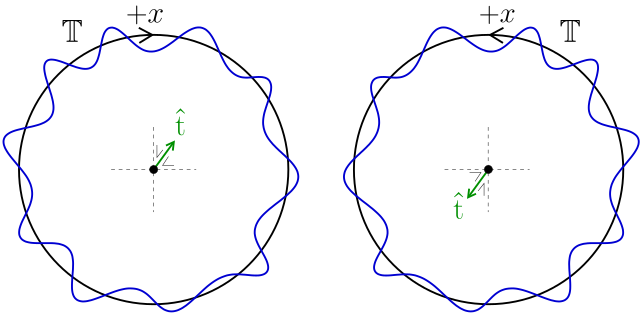
Let us focus on the case in which ${b(k)}$ has both real and imaginary parts, which means that there exists an unexplained degeneracy. It will be useful to consider Fig. 18: In the schematic on the left hand side, each point on the black circle represents a different point ${x\in\onetorus}$; and the radial displacement of the blue curve from the black circle represents the real part of ${b_k=b(k)\in\lebesgue(\onetorus)}$ at $x$.
where ${\ket{x}}$ denotes the counterpart in $\hilbert$ of an element of ${\lebesgue(\onetorus)}$ that is localized around a point ${x\in\onetorus}$ (see Appendix C). Also recall from Sec. 2.3.6 that the inner product of ${\ket{x}}$ and ${\ket{b(k)}}$ is not ${\braket{x}{b(k)}}$, but ${\Re\left\{\braket{x}{b(k)}\right\}}$; and that ${\Im\left\{\braket{x}{b(k)}\right\}}$ does not have any meaning unless the space ${\Span\left\{\ket{x},\ket{b(k)}\right\}}$ is embedded in a higher dimensional space.
In Fig. 18, ${\ket{b(k)}}$ represents the blue curve, ${\ket{x}}$ represents a function localized at a point $x$ on the black circle, and ${\Re\{\braket{x}{b(k)}\}}$ is the radial displacement of the blue curve from the black circle at that point. Therefore, if ${b_k(x)}$ has an imaginary part, the plane in which the black circle resides (the plane of the page) must be embedded in a higher dimensional space. This is because, as noted in Sec. 2.3.6, ${i\Im\{b_k(x)\}}$ represents the outer product of ${\ket{x}}$ and ${\ket{b(k)}}$, which is a bivector. The vector ${\hat{\mathrm{t}}}$ resides in that higher dimensional space, and is perpendicular to the plane of the page.
The axis parallel to $\hat{\mathrm{t}}$ might be the time axis, or it might be a spatial axis, or it might have temporal and spatial components, or it might not be an axis in spacetime. If it is an axis in spacetime, and since real crystals are three dimensional, it is usually regarded as the time axis. Regardless of what axis it is, the schematic on the right hand side of Fig. 18 shows the plane of the circle from the opposite side.
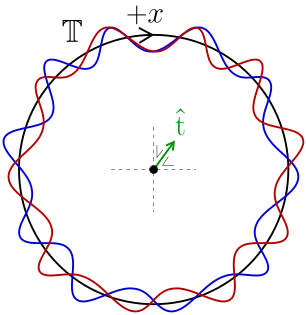
Now, since the blue curve in Fig. 18 is an eigenfunction ${b_k(x)}$ of ${\hamsmallx}$; and since ${\hamsmallx}$ does not depend on the ‘side’ of the plane that the torus is on (i.e., on whether ${\hat{\mathrm{t}}}$ points into or out of the plane), both sides of the plane must be equivalent. In other words, if all of the eigenfunctions of ${\hamsmallx}$ with a given eigenvalue were plotted, the set of curves would appear the same from both sides of the plane. This can only be the case if there exists an eigenfunction that looks just like ${b_k(x)}$ when it is viewed from the opposite side of the plane of $\onetorus$.
That eigenfunction is the red curve in Fig. 19, which is identical to the blue curve on the right of Fig. 18. The symmetry that relates the red curve and blue curve is usually referred to as time inversion symmetry. However, it is clear from Fig. 18, that inverting ${\hat{\mathrm{t}}}$ would be equivalent to changing the positive $x$ direction from clockwise to anticlockwise, i.e.,
This demonstrates that any Bloch eigenfunction, which is associated with any wavevector ${k\in\BZ}$, is doubly degenerate as a consequence of $\hamsmallx$ being independent of the parity of ${\hat{\mathrm{t}}}$ and the positive ${x}$ direction. In simple terms, if you close your fists and extend your thumbs, and imagine that your thumbs are parallel to $\hat{\mathrm{t}}$, the fingers of only one of your hands go around its thumb in the positive $x$ direction. The Hamiltonian $\hamsmallx$ does not depend on which hand this is. This independence is the symmetry responsible for ${b(k,x)}$ and ${b(-k,x)}$ having the same eigenvalue. We may call it parity inversion symmetry, but it is more commonly referred to as time inversion symmetry.
Figure 18. The black circles on the left and right are the
$1$-torus $\onetorus$, which inhabits the
Cartesian ${y-z}$ plane. The radial displacement of
the blue curve from the black circle is the value ${b_k(x)}$ of a $\bulksize$-periodic
function ${b_k:\onetorus\to\realone}$, ${x\mapsto b_k(x)}$.
The only difference between the two figures is that, on the left
the torus is viewed along the positive $t$ direction, whereas
on the right it is viewed along the negative $t$ direction.
Figure 19. The same as the left panel of Fig. 18, but with
the addition of the red curve. The red curve
is identical to the blue curve in the right panel of Fig. 18.
Since the blue curve is a eigenfunction
of a Hamiltonian that is independent of whether
${\hat{\mathrm{t}}}$ is directed into the page or out of the page,
there must exist another eigenfunction, with the same eigenvalue,
whose shape is the same as blue curve when it is viewed
from the opposite side of the plane. That solution is the red curve.
G.7 Notation, normalization, and orthogonality
In general, $\hamsmallx$ has an infinite number of different eigenvalues. Since no assumptions were made about $\varphi$, everything in this appendix from Appendix G.3 onwards applies to each eigenfunction independently. Therefore, for every different eigenvalue $\epsilon$ of $\hamsmallx$ there are two Bloch eigenfunctions that are equivalent to one another under parity inversion symmetry, each of which is associated with a different element of $\BZ$. If one of them is associated with ${k\in\BZ}$, the other is associated with ${-k\in\BZ}$.
Since ${\hamsmallx}$ has an infinite number of eigenfunctions, whereas ${\BZ}$ is a finite set, there are an infinite number of eigenfunctions associated with each element $k$ of $\BZ$. Therefore, each eigenfunction is usually identified by a double index ${\alpha k}$, where index $\alpha$ distinguishes between different eigenfunctions at the same wavevector $k$. In other words, the elementary eigenfunctions of ${\hamsmallx}$, can be expressed as
where ${u_{\alpha k}(x)\equiv u_\alpha(k,x)}$ is ${\volume}$-periodic.
Here and in Sec. 14 and Appendix H it will sometimes be convenient to denote the Bloch functions as ${b_\alpha(k,x)}$ and the periodic Bloch functions as ${u_\alpha(k,x)}$. At other times it will be convenient to denote them as ${b_{\alpha k}(x)}$ and ${u_{\alpha k}(x)}$, respectively. Therefore these notations will be used interchangeably. Similar interchangeable notations will be used for eigenstates and eigenvalues, namely, ${\epsilon_{\alpha k}\equiv \epsilon_\alpha(k)}$ and
Since ${\braketT{b_{\alpha k}}{b_{\alpha k}}=\braketT{u_{\alpha k}}{u_{\alpha k}}}$, each Bloch function ${b_{\alpha k}}$ bestows its unit normalization on its periodic counterpart, ${u_{\alpha k}}$. However, the set of periodic Bloch functions does not inherit orthogonality from the set of Bloch functions, in general, i.e.,
Comments