As discussed in Sec. 6.8, unless it is prohibited by symmetry, a polarization current $\Jconv$ flows through the bulk of a material in response to any stimulus ${\zeta\to\zeta+\Delta\zeta}$, where $\zeta$ might be temperature, an externally-applied electric, magnetic, or stress field, or anything else that changes the material’s equilibrium or steady-state-nonequilibrium microstructure.
13.1 Polarization current as a rate of change of surface charge
When all charge that flows through the bulk, by any mechanism or in response to any stimulus, accumulates at surfaces, the current density deduced from Eq. (59) is simply
Therefore, the current can be calculated if the time-dependent charge density ${\rho(x,t)}$ (or $\Rho$) is known everywhere. However, the amount of charge that can flow in an isolated material is limited, and surface microstructures tend to be more difficult to calculate than microstructures in the bulks of crystalline materials. Therefore, we would like to be able to calculate ${\Jconv}$ from the evolving equilibrium bulk microstructure.
If we can partition the electron density of a crystal into packets, we can use Eq. (64) to express the current density as
where each pair $(x_i,q_i)$ is either the position and charge of a nucleus or the center and ${-e}$ times the integral of a packet $n_i$ of electron density; and where ${x_b}$ has been chosen to not coincide with any of the $x_i$’s.
Let us denote ${(x_b,x_b+a)}$, which is a primitive unit cell of the crystal, by $\unitcell$; let us denote the sum of all $n_i$ whose centers are in $\unitcell$ by
and let us denote the charge distribution of the nuclei in $\unitcell$ by ${\rhop_\unitcellscr(x,t)}$. Finally, let us assume that the packets $n_i$ have been chosen such that the integral of
where ${a=\volume}$ is the lattice constant and $ma$ is a lattice vector.
We have realised the situation described in the discussion of Fig. 3 in Sec. 7: We have partitioned the charge density of the electrons in the crystal’s bulk into a set of identical non-positive charge densities that are displaced from one another by lattice vectors; and because the bulk must remain charge neutral, the integral $\Neleccell$ of $n_\unitcellscr$ remains constant. Therefore the polarization current is given by
where ${X_\unitcellscr^+}$ and ${X_\unitcellscr^-}$ are the centers of charge of ${\rhop_\unitcellscr}$ and ${\rhom_\unitcellscr}$, respectively; and I have used the fact that the sum of all the positive $q_i$’s in $\unitcell$ and the sum of all the negative $q_i$’s in $\unitcell$ are both time independent and equal to ${e\Neleccell}$ and ${-e\Neleccell}$, respectively.
If each packet $n_i$ has an integral that remains constant, the polarization current can also be expressed as
Although the result for crystalline systems appears to be exact and precise, there are variations (${\sim a/\ell}$) in the value for amorphous systems with the choices of $x_b$ and $\ell$. The source of these variations is differences in the averages of ${\dot{q}_ix_i+q_i\dot{x}_i}$ on different intervals. Furthermore, because the net charge ${Q=\sum_{i:x_i\in \interval(x_b,\ell)}q_i}$ of interval ${\interval(x_b,\ell)}$ is not zero, in general, the value of $\Jconv$ calculated from this expression has an origin dependence unless $Q$ is constant. In practice, it may be easier to find a set of packets $n_i$ whose integrals are constant (${\implies\dot{q}_i=0}$) and to calculate
If we define the conduction current as ${\Jcond\equiv\J-\Jconv}$, and if ${\normal}$ is a surface’s unit-magnitude outward normal, then ${\Jcond\cdot\normal}$ is simply equal to $-e$ times the sum of the rates of change of the integrals of the packets $n_i$ whose centers are in the surface region, i.e.,
Regardless of the choice of $x_b$, this does not contain any contribution from bulk-like primitive cells, because ${\sum_{i:x_i\in\unitcell}\dot{q}_i}$ vanishes for each bulk-like unit cell $\unitcell$.
13.2 $\hilbert$-representability and ${\hilbert(t)}$-representability of $n$
I have established that $\Jconv$ can be calculated from any evolving bulk microscopic charge density ${\rho(x,t)}$ that can can be expressed as a sum ${\sum_i \rho_i}$ of moving packets of fixed amounts charge, each of which is either non-positive or non-negative. When such a representation exists, it is not unique because, for example, one can always add to any given representation a co-moving pair of packets of equal and opposite charge, or combine multiple packets into a single packet.
Clearly the distribution of nuclear charge admits such a representation, so in this section I focus on electrons.
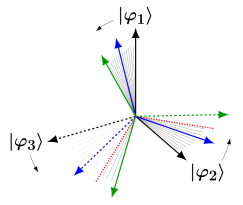
Figure 13.
Consider the ground state number density ${n(x;\zeta)}$
of two spin-zero electrons in a static confining potential ${\vext(x;\zeta)=-e\varphi(x;\zeta)}$, where
${\zeta}$ is some physical parameter (e.g., $\Eext$).
Since ${n(\zeta)}$
is arbitrarily close to a non-interacting $v$-representable density [van Leeuwen, 2003],
it can be represented as a two dimensional Hilbert subspace
${\hilbert_\zeta\equiv \SPAN\left\{\ket{\varphi_1(\zeta)},\ket{\varphi_2(\zeta)}\right\}}$,
of ${\hilbert_\infty}$, which is
an abstract representation of
${\lebesgue(\realone)}$: If ${\P_\zeta}$ is a projector onto subspace
$\hilbert_\zeta$, the density is ${n(x;\zeta) = \expvaltwo{\P_\zeta}{x}}$.
In the schematic above, ${\ket{\varphi_1(\zeta)}}$ and ${\ket{\varphi_2(\zeta)}}$
are depicted, for some value of $\zeta$, as solid black arrows; and ${\ket{\varphi_3(\zeta)}}$,
which is in the orthogonal complement ${\hilbert_\zeta^\perp}$ of ${\hilbert_\zeta}$, is the
black dashed arrow.
If ${\zeta}$ changes continuously, and while
${n(\zeta)}$'s response to this change is non-singular, ${\hilbert_\zeta}$
rotates continuously within $\hilbert_\infty$. Therefore
${\ket{\varphi_1(\zeta)}}$ and ${\ket{\varphi_2(\zeta)}}$ change continuously (from black to blue)
by mixing with vectors from ${\hilbert_\zeta^\perp}$. However, since the two states ${\ket{\varphi_i(\zeta)}}$
that contribute to the density are those with the lowest eigenvalues ${\epsilon_i(\zeta)}$ of a Hamiltonian
${\hamsmall(\zeta)}$, there may exist a critical
value ${\zeta_c}$ (dotted red lines) at which
${\epsilon_3}$ becomes lower than ${\epsilon_2}$.
At ${\zeta=\zeta_c}$,
${\hilbert_\zeta}$ changes abruptly to ${\SPAN\left\{\ket{\varphi_1(\zeta)},\varphi_3(\zeta)\right\}}$,
resulting in a discontinuous redistribution of electron density in $\realone$.
Before the dotted red line is reached, the rotation of $\hilbert_\zeta$ manifests as a polarization current,
where ${\dot{x}_i}$ denotes the time derivative of the center of ${\abs{\varphi_i(x;\zeta)}^2=\abs{\braket{x}{\varphi_i(\zeta)}}^2}$;
and $\Jconvm$ could be calculated from Eq. (67) for any
basis ${\{\ket{\varphi_1(\zeta)},\ket{\varphi_2(\zeta)}\}}$ of ${\hilbert_\zeta}$.
However, the current that flows when ${\hilbert_\zeta}$
changes discontinuously at ${\zeta=\zeta_c}$ is not polarization current and cannot be calculated in this way.
When the density's response is singular, multiple basis
vectors can be exchanged between ${\hilbert_\zeta}$ and ${\hilbert_\zeta^\perp}$ in less
time than it takes for electrons to respond. In that case the MTOP
approach fails because, for example, if ${\ket{\varphi_i(\zeta)}}$ and ${\ket{\varphi_j(\zeta)}}$ are replaced in
${\hilbert_\zeta}$'s basis by
${\ket{\varphi_k(\zeta)}}$ and ${\ket{\varphi_l(\zeta)}}$, the value of $\Jconvm$ calculated
by assuming that the density at ${x_i}$ was displaced by ${x_k-x_i}$ to ${x_k}$ and
the density at ${x_j}$ was displaced by ${x_l-x_j}$ to ${x_l}$, would differ, in general,
from the value calculated by assuming that
the densities at ${x_i}$ and ${x_j}$ were displaced to
${x_l}$ and ${x_k}$, respectively.
13.2.1 Electrons
I say that a number density ${n(x)}$ is $\hilbert$-representable if there exists a projector $\P$ onto a Hilbert space of dimension ${\Nelec=\int n}$ such that ${n(x)=\expvaltwo{\P}{x}}$. I say that a number density ${n(x,t)}$ is ${\hilbert(t)}$-representable (‘Ht representable’) if it is ${\hilbert}$-representable at all relevant times $t$ and if its time-dependent projector ${\P(t)}$ evolves smoothly with $t$.
It is known that the ground state electron density of any material is either noninteracting $v$-representable or arbitrarily close to a noninteracting $v$-representable density [van Leeuwen, 2003]. This means that it can be represented as a set of packets ${n_i=\abs{\varphi_i}^2}$ of integral one (two for spin-degenerate packets), where the ${\varphi_i}$’s are the lowest-eigenvalue eigenstates of a single electron Hamiltonian, $\hamsmall$.
I make an adiabatic approximation by assuming that the ground state density’s time dependence can be expressed as a parametric dependence on a slowly- and smoothly-varying stimulus ${\zeta(t)}$. I express it as
is a projector onto the Hilbert space ${\hilbert_\zeta}$ spanned by the $\Nelec$ eigenvectors ${\ket{\varphi_i(\zeta)}}$ of the single electron Hamiltonian ${\hamsmall(\zeta)}$ with the lowest eigenvalues. ${\hilbert_\zeta}$ is an $\Nelec-$dimensional subspace of ${\lebesgue(\realone)}$, the infinite-dimensional Lebesgue space of real- or complex-valued square integrable functions on ${\realone}$. It changes as $\zeta$ changes and the eigenstates of ${\hamsmall(\zeta)}$ change.
To understand the representability problem, it may be useful to visualize it as it is depicted in Fig. 13. In an insulator each vector in the basis ${\{\ket{\varphi_i(\zeta)}\}_{i=1}^{\Nelec}}$ of ${\hilbert_\zeta}$ changes gradually with $\zeta$ as vectors from its orthogonal complement ${\hilbert_\zeta^\perp}$ are mixed into them. Therefore ${\hilbert_\zeta}$ rotates smoothly within ${\lebesgue(\realone)}$ as $\zeta$ changes. This is because there is a gap in the eigenspectrum of ${\hamsmall(\zeta)}$ between the ${\Nelec^\text{th}}$ and the ${(\Nelec+1)^\text{th}}$ lowest eigenvalues, which never closes as $\zeta$ changes. In a metal, by contrast, the $\Nelec^\text{th}$ eigenvalue is in a region of the spectrum where there is a quasicontinuum of eigenvalues. As $\zeta$ changes, the ordering of the eigenvalues is quasicontinuously changing, and each time the $\Nelec^\text{th}$ eigenvalue and the ${(\Nelec+1)^\text{th}}$ eigenvalue cross, the ${\Nelec^\text{th}}$ basis vector ${\ket{\varphi_{\Nelec}(\zeta)}\in\hilbert_\zeta}$ is replaced with a vector ${\ket{\varphi_{\Nelec+1}(\zeta)}\in\hilbert_\zeta^\perp}$ to form ${\hilbert_{\zeta+\dd{\zeta}}}$.
The serene rotation of the basis vectors in a insulator is illustrated by the rotation of the basis ${\{\ket{\varphi_1},\ket{\varphi_2}\}}$ in Fig. 13before${\ket{\varphi_2}}$ reaches the red dashed line, which indicates where the second and third eigenvalues become equal in this two-electron example. As soon as the variation of $\zeta$ rotates $\ket{\varphi_2}$ past the red line, ${\hilbert_\zeta}$ changes abruptly from ${\SPAN\{\ket{\varphi_1},\ket{\varphi_2}\}}$ to ${\SPAN\{\ket{\varphi_1},\ket{\varphi_3}\}}$. The quasicontinuum of eigenvalues in a metal means that, instead of ${\hilbert_\zeta}$ smoothly rotating, there is a rapid click-clacking of vectors in and out of its basis.
If $\zeta$ changes infinitely slowly, the electrons have time to reach, and settle at, each instantaneous $\hilbert$-representation before it changes. The system can then be assumed to be close to equilibrium almost all of the time. However immediately after each exchange of basis vectors between ${\hilbert_\zeta}$ and ${\hilbert_\zeta^\perp}$, it could be far from equilibrium. This is likely to be the case if states are widely-separated spatially, such as when they are localized on opposite surfaces or on oppositely-charged electrodes attached to different parts of the material. At values of $\zeta$ at which the $\hilbert$-representation changes, the response of ${n(x;\zeta)}$ to changes of $\zeta$ is singular and occurs via a nonequilibrium dynamical process involving many electrons, in general.
If the exchange of basis vectors between ${\hilbert_\zeta}$ and ${\hilbert_\zeta^\perp}$ occurs frequently, as is the case in a metal, the electron density does not have time to reach each new $\hilbert$-representation before it changes again. Therefore the response of electrons in a metal to applied fields is singular and governed by nonequilibrium dynamics.
In an insulator $\hilbert_\zeta$ rotates smoothly and its dimension is ${\gtrsim 10^{24}}$ for materials at the human scale. The set of vectors that span it can always be transformed unitarily among themselves to localize them or delocalize them. These transformations do not change $\hilbert_\zeta$ or the projector ${\P_\zeta}$, which means that they do not change the density ${n(x;\zeta)=\expvaltwo{\P_\zeta}{x}}$ or the current $\Jconv$. Therefore, although it is common to transform the eigenfunctions of ${\hamsmall(\zeta)}$ to a more localized set of basis functions by linearly combining them, in principle this is not necessary.
Comments