9. Excess fields
https://doi.org/10.48550/arXiv.2403.13981
9.1 Introduction
As discussed in Sec. 8, macrostructure essentially consists of smoothly-varying continua interspersed with heterogeneitites such as defects, interfaces, and inclusions.An inclusion is an embedded region whose microstructure differs from that of its host. If all of its dimensions are smaller than ${\prectheo=\dbx}$, an inclusion is a singular point in the volumetric macroscopic field $\Nu$ and therefore a macroscale point defect. Similarly, a macroscale line [planar] defect is an inclusion that is larger than ${\prectheo}$ along only one [two] of its dimensions. Macroscale defects may require special treatments when applying the macroscale theory, but their macrostructures can be calculated from the microstructures by reasonably-straightforward application of the three-dimensional mesoscale averaging operation.
Macroscale defects should not be confused with their microscale counterparts. For example, consider vacancies and impurities in crystals, which are microscale point defects. Although they may be charged, and therefore may contribute directly to the microscopic charge density $\rho$, and they may perturb the arrangement of atoms, thereby indirectly changing $\rho$, their concentrations are usually high enough and/or their effects on averages of $\rho$ small enough, that they can be regarded as just another feature of the microstructure. Their presence in a crystal does not alter the relationship between $\Rho$ and $\rho$ in most cases.
Exceptionally, microscopic defects might increase the upper bound, $\amax$, on distances regarded as microscopic so much that it becomes comparable to $\Lmin$, thereby rendering Physical Assumption 6, and much of the theory presented in Sec. 8 invalid. However, I restrict attention to systems in which ${\amax\ll\Lmin}$.
If all of an inclusion’s dimensions are much larger than ${\prectheo}$, the curvature of its macroscale boundary with the host material will be negligible on the mesoscale. Therefore, the inclusion is simply another macroscale material whose boundary with its host is locally flat. On either side of that boundary $\Nu$ is differentiable and the boundary itself can be treated like any other mesoscopically-planar interface. As discussed in Sec. 8, not only does $\Nu$ tend to be discontinuous at interfaces, but interfaces carry excesses ${\bsigmaNu}$ of $\Nu$, in general, which play important roles in physics at the macroscale.
I am trying to emphasise that, for a large class of systems, and from a practical perspective, the only ingredient of a mutually-consistent description of macrostructure and microstructure that we lack is the relationship between microstructure $\nu$ and the macroscale interfacial excess $\bsigmaNu$. The purpose of this section is to derive this relationship. Specifically, I derive expressions for excesses at surfaces (interfaces with a vacuum), which are trivial to generalize to interfaces by treating them as adjoined surfaces.
9.1.1 Notation
In this section, and henceforth, I will assume that $\Nu$ is a single-valued field at the macroscale, which is a mesoscale spatial average of $\nu$ that I will often denote by ${\bnu}$. At the microscale I will denote the midpoint of interval ${\Nu(\bx)\equiv\interval(\bbNu(\bx),\precNu)}$, by ${\bNu(\barx(\bx))}$, and I will assume that ${\bbNu(\bx)}$ is the average of ${\bNu(x)}$ over all ${x\in\coincidence{\barx(\bx)}}$.As in Sec. 8.9, ${\intmax=\intmax(\prectheo)>\prectheo}$ will denote the mesoscopic width of the domain of a mesoscale spatial average. Increasing its value makes the approximation
In Fig. 9, while considering the example of a top-hat kernel, I defined ${\prectheo=\abs{\dbx}}$ such that if the distance between two macroscale points was greater than ${\abs{\dbx}/2}$, they could be distinguished from one another, with certainty, by macroscale measurements. However, real measurements do not provide certainty - only probabilities and degrees of certainty.
In this section I will consider spatial averages with an arbitrary kernel, but to avoid cluttering and complicating the theory and discussion, I will not discuss probabilities. I will continue to refer to $\prectheo$ as the macroscopic spatial precision, and as the width of an interface at the microscale, but with the understanding that ${\prectheo/2}$ is now the standard deviation of the position probability density function, ${\mu(\prectheo)}$. In other words, I will continue to use precise non-probabilistic language and mathematics, while cognisant of the fact that this preciseness is unjustified. For example, I will continue to regard the coincidence set ${\coincidence{\barx(\bx)}}$ of $\bx$ as a well-defined set of points, and I will continue to discuss an interface as having the precisely-defined width, $\prectheo$.
If this sloppiness introduces doubt about the validities of the derivations that follow, this doubt can be removed by strengthening our physical assumptions about the nature of microstructure: We can assume that ${\amax/\prectheo}$ and ${\prectheo/\Lmin}$ are both so small that the shape of $\mu$ has a negligible influence on the macrostructure (see Eq. (32)). Then $\mu$ is effectively a top-hat kernel. To achieve further comfort, by reverting to perfect consistency with our discussion of top-hat kernels in Sec. 8, we could mentally replace every instance of ${\mu(\prectheo)}$ in what follows with ${\mu(\prectheo/\sqrt{3})}$.
9.2 Surface excesses in three dimensions
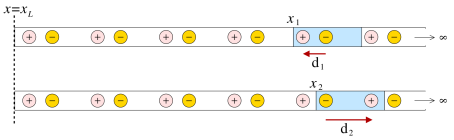
Far from an interface, the relationship between the macrostructure and the microstructure is as described, but not rigorously and precisely defined, in Sec. 8. Homogenizing the interface region presents new problems as a consequence of the fundamental difference between interfaces at the macroscale and interfaces at the microscale, which I briefly discussed in Sec. 8.3.1. These are that interfaces are ill-defined at the microscale, because their widths are indeterminate, whereas at the macroscale they are well-defined two dimensional manifolds which carry excess fields.In Sec. 8.3.1 we considered excesses of one dimensional microstructures. Let us begin our discussion of excesses of three dimensional microstructures by considering an excess field on a surface that is perpendicular to the $\bx-$axis and whose macroscale $\bx-$coordinate is $\mxl$ (see Fig. 11). Let ${x_L\equiv\barx(\mxl)}$. Above the surface, by which I mean ${\bx<\mxl}$ at the macroscale and ${x<x_L-\prectheo/2}$ at the microscale, there is vacuum, meaning that both ${\nu}$ and ${\Nu}$ are zero. Let us assume that $\Nu$ is also zero far below the surface, but that the average $\yznu(x)$ of $\nu$ on the plane parallel to the surface at $x$ does not vanish for every $x$. This means that the mesoscale average of $\nu$ only vanishes if
It follows that if we create a surface perpendicular to the $\bx-$axis by removing all material from one side of an imaginary plane passing through the bulk, the removal of this material disrupts the cancellation that causes $\Nu$ to vanish. Therefore, within ${\pm\prectheo/2}$ of the surface, ${\Nu}$ does not vanish. The integral of $\Nu(\bx,\by,\bz)$ between any point above the surface, ${\bx_1<\mxl-\absdbx/2}$, and any point below it, ${\bx_2>\mxl+\absdbx/2}$, is
9.3 Calculating interfacial excesses from the microstructure
To address the question of how excess fields can be calculated from the microstructure, $\nu$. let us continue to assume that the $x$-axis is normal to the surface and, to simplify the notation by keeping the problem one-dimensional, let us assume that $\nu(x)$ is the average of some other microscopic quantity on the plane parallel to the surface at $x$. As before, let us assume that ${\Nu=0}$ in the bulk. An obvious starting point is to define the microscale surface excess, $\sigma_\nu$, asTo see that ${\bsigmaNu\equiv\sigma_\nu(x_b)}$ is not a good definition of the macroscale surface excess, consider the example depicted in Fig. 11. In this example, the material could be a three dimensional crystal and $\nu$ the average of the charge density over planes parallel to the surface. The value of $\nu$ is zero everywhere except at a discrete set of $x-$values, corresponding to lattice planes, on which it is either $+1$ or $-1$. Therefore, calculating $\sigma_\nu(x_b)$ is as simple as counting these charges from $x<x_L$ to $x=x_b$. By inspection, we find that ${\sigma_\nu(x_1)=0}$ and ${\sigma_\nu(x_2)=+1}$, where $x_1$ and $x_2$ are the positions indicated in Fig. 11. If one continues counting beyond ${x=x_2}$, the value of $\sigma_\nu$ continues to jump between $0$ and $+1$ and it never converges.
The problem with defining ${\bsigmaNu\equiv\sigma_\nu(x_b)}$ is twofold. First, identifying ${\sigma_\nu(x_b)}$ as the surface excess appears to imply that ${x<x_b}$ is the surface region and ${x>x_b}$ is the bulk. However, as discussed in Sec. 8.3.1, there is no clear boundary between surface and bulk at the microscale and so the "surface region" is ill-defined. Second, although $\Nu$ vanishes in the bulk, the same is not true of $\nu$, and any integral of a microscopic quantity is a microscopic function of its upper and lower bounds of integration. Therefore, $\sigma_\nu(x_b)$ fluctuates microscopically as $x_b$ is varied.
This simple example, which is typical rather than pathological, illustrates how interfaces being ill-defined at the microscale can be troublesome when one attempts to calculate macroscale properties of interfaces from the microstructure. It also underscores the importance of a careful understanding of the relationship between microscale physics and macroscale physics.
To deduce the relationship between $\bsigmaNu$ and $\nu$, consider the following two slightly-different lines of reasoning. The first is to define $\bsigmaNu$ as the mesoscale average of $\sigma_\nu(x_b)$. This means that, instead of terminating the integral at a single plane (at $x_b$) we take an average over an ensemble of terminating planes. This was the approach taken by Finnis [Finnis, 1998], who appears to have been the first to solve the problem of calculating what he called thermodynamic excesses of charge and other quantities at interfaces. In [Finnis, 1998] he reasoned that, by averaging over terminating planes, "we can reconcile the atomistic picture, in which excesses appear to oscillate on the atomic length scale as a function of the region size, with the thermodynamic picture". He used this approach to derive an expression for the surface charge in crystals. One purpose of Sec. 9.8 is to generalize his result to noncrystalline materials.
The second line of reasoning, which may seem more natural in the present context, begins with the fact that surfaces, and therefore surface excesses, are only well-defined at the macroscale. Therefore, $\bsigmaNu$ must be the integral of $\Nu$ across the surface, i.e.,
9.4 Changes of macroscale quantities across interfaces
To calculate the change in $\Nu$ between a point ${\bx_2}$ on one side of an interface and a point ${\bx_1}$ on the other, one could simply calculate ${\Nu(\bx_1)}$ and ${\Nu(\bx_2)}$ from the microstructure, $\nu$. However, this is not always the easiest approach. For example, if ${\dnu{1}}$ is known, but $\nu$ is not, it might be easier to recognise that the change of $\Nu$ across the interface is the interfacial excess of $\dNu{1}$. Therefore,For the purposes of calculating the interfacial excesses, and step-changes in macroscopic quantities across interfaces, that are required in this work about electricity, we only need to deduce relationships between the right-hand-sides of Eq. (40) and Eq. (41) and the microstructures $\nu$ and $\psi$, respectively. Mathematically, the problem at hand is to find simple and general expressions for
9.5 Mesoscale averages of integrals
The goal of this section is to deduce general relationships between the microstructure and the integral averages in Expression Eq. (42), which are equivalent to the right-hand-sides of Eq. (40) and Eq. (41), apart from the appearance of $\bpsi$ instead of $\Nu$ in the latter.Calculating the integral of ${\bNu}$, which is constant or linear on both sides of an interface, is straightforward. Therefore, let us define ${\Dnu(x)\equiv \nu(x)-\bNu(x)}$, and instead calculate the mesoscale average over $x_b$ of
Apart from those stated and discussed in Sec. 8, we will not make any assumptions about the microstructure. Therefore, our goal of deriving generally-applicable expressions for $\mbs_r$ in terms of $\nu$ is only possible if $\mbs_r$ can be related to some calculable characteristics of the microstructure. Guided by Finnis’s expression for the surface excess [Finnis, 1998], we will characterize the microstructure using moments and moment densities. This is explained in Sec. 9.6 and Sec. 9.7.
9.6 Partitioning space into microscopic intervals
To characterize the microstructure in the mesoscopic neighbourhood of $x_b$, let us assume that the macrostructure is either uniform or linearly-varying in this neighbourhood. Let us partition an interval of width $\intmax$ centered near $x_b$ into a set of $2 M$ contiguous microscopic subintervals, or microintervals, demarcated by the set of pointsNow let us place one further constraint on $\Pi(x_b,\intmax)$, which explains why $x_b$ is not the midpoint of $(x_\mm,x_\m)$: The microinterval boundary points are chosen such that ${\expval{\Dnu}_{\Delta_m}(\bar{x}_m)=0}$ for all $m$, which implies that ${\bnu(x)=\bNu(x)}$. This choice is possible because $\Dnu$ fluctuates microscopically about zero everywhere in ${\interval(x_b,\intmax)}$. Therefore, starting from $x_b$, the nearest point $x_1>x_b$ such that the average of $\Dnu$ on ${[x_b,x_1]}$ is zero must be a microscopic distance $\Delta_1$ away. The nearest point $x_2>x_1$ such that ${\expval{\Dnu}_{\Delta_2}(\bar{x}_2) = 0}$ is a microscopic distance $\Delta_2$ away, and so on. Having chosen a set $\Pi(x_b,\intmax)$ for which the average of $\Dnu$ on each microinterval vanishes, Eq. (44) becomes
9.7 Characterising microstructure with moment distributions of microscopic intervals
Let us characterise the microstructure in interval $m$ by the set of moment densitiesLet us define the mesoscale average ${\bmany(x_b)}$ of ${\many(\bar{x}_m,\Delta_m)}$ as follows.
In general, the average moment densities $\bar{\mathcal{M}}_\nu^{(n)}$ can depend strongly on the choice of $\Pi(x_b,\intmax)$ and so they are not physically very meaningful. Nevertheless, we will see that it is possible to derive useful expressions that relate them to macroscopic observables, and which are valid for any choice of $\Pi(x_b,\intmax)$ that satisfies the conditions specified above.
In a crystal whose periodicity along the $x-$axis is $a$ (i.e., ${\nu(x+a)=\nu(x), \;\;\forall x}$), the $\expval{\;.\;}^*$ average is unnecessary because, by choosing ${\Delta_m=a,\;\;\forall m}$, all microintervals are identical and so
9.8 Surface excess
Eq. (43) can be written asNow let us split the integral in Eq. (45) into a sum of integrals over the microintervals, ${\interval_m\equiv\interval(\bar{x}_m,\Delta_m)}$. We can again exploit the slowness of the variation of $\mu$ and $\mathcal{F}_\mu$ on the microscale, when ${\amax/\prectheo}$ is very small, to replace $\mathcal{F}_\mu(x-x_b;\prectheo)$ in each microinterval by its Taylor expansion about the microinterval midpoint. If ${\amax/\intmax}$ is sufficiently small, we can discard the second and higher-order terms, which involve first- and higher-order derivatives of $\mu$. Therefore, we get
9.8.1 Case I: $\mbs_0$
Setting $r=0$ in Eq. (46) givesas ${\bsms_0=\bsms_{0,s}(x_b)+\bsms_{0,b}(x_b)}$, we find that
9.8.2 Case II: $\mbs_1$ when $\Nu(\bm{x_b})=\bm{0}$
Returning to Eq. (46), setting $r=1$, and using the fact that, for all $m$,9.8.3 Idempotency of the mesoscale average
In Sec. 8.9 we assumed, implicitly, that the mesoscale averaging operation is not idempotent. This allowed us to deduce that there is a trade-off between spatial precision/uncertainty and the precision/uncertainty of macroscopic fields and their derivatives. However, the uncertainty relations were derived under a ‘first approximation’, and are far from exact. Throughout Sec. 9 we have assumed that we are much closer to the limit ${\amax/\prectheo\to 0}$, and therefore closer to the limit in which the averaging operation is idempotent. Bearing this in mind, let us consider one important consequence of idempotency.Idempotency of the averaging operation would allow the following deduction to be made about the mesoscale averages, $\boldmone$ and $\boldmtwo$, of ${\bmone}$ and ${\bmtwo}$, respectively.
Comments