3. Assumptions about materials' structures
https://doi.org/10.48550/arXiv.2403.13981
This section outlines some of the physical assumptions about materials’ structures that are made in this work. More physical assumptions are introduced in later sections, as and when they are needed. Most of the physical assumptions that are introduced in later sections are neither strong nor significant. However Sec. 8 introduces physical assumptions that significantly narrow the range of materials to which parts of this work apply. For example, they are not all valid in materials whose textures are non-uniform on all length scales, such as wood.
3.1 Length scales
The microscale, $a$, is the smallest length scale of relevance to the physics of materials, and the macroscale, $L$, is a much larger length scale, on which materials appear continuous rather than particulate.Whenever I use the prefixes micro and macro it is implicit that there also exists a mesoscale $l$, where ${a\ll l \ll L}$. The mesoscale is an intermediate length scale, which is orders of magnitude larger than a bond length, but small enough that all nonlinear contributions to the spatial variations of all macroscopic fields are negligible on scale $l$. The assumption that there exists a mesoscale is useful, and possibly necessary, for understanding the relationship between microstructures and macrostructures.
The statements ${\Delta_a\sim a}$, ${\Delta_l\sim l}$, and ${\bDelta_L\sim L}$, mean that ${\Delta_a}$, ${\Delta_l}$, and ${\bDelta_L}$ are distances or displacements which are microscopic, mesoscopic, and macroscopic, respectively. I will explain precisely what I mean by the terms microscopic, mesoscopic, and macroscopic in Sec. 8.
In Sec. 8 I will define the macroscale infinitesimal ${\abs{\dbx}}$, which is a lower bound on lengths and distances that are measurable at the macroscale. At the microscale I denote ${\abs{\dbx}}$ by ${\prectheo}$
I denote the smallest measurable distance at the microscale by ${\abs{\dd{x}}\equiv\precmicro}$. Its value can be arbitrarily small, as long as it is finite and an inviolable lower bound.
3.2 A quasi-one dimensional material
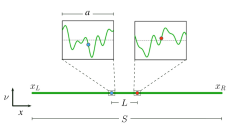
The planes perpendicular to the page at ${x=\xl}$ and ${x=\xr=\xr+S}$ bound the material in the ${-\htx}$ and ${\htx}$ directions, respectively, where $S$ is the length of the material. Therefore ${\nu(x)}$ is negligible when ${x\notin(\xl,\xr)}$.
The bulk macrostructure is depicted as uniform in Fig. 1, which is not the general case. For example, I do not make any assumptions about the macroscopic charge density $\Rho$, except that it is differentiable almost everywhere. By this I mean that it is differentiable everywhere except where it changes nonlinearly on an interval of width ${\prectheo=\abs{\dbx}}$.
For example, as I explain in Sec. 8, a surface is assumed to have a width of less than ${\prectheo}$ at the microscale. This is not a physical assumption about the surface, but a consequence of the definition of ${\prectheo}$. It means that the microscopic charge density $\rho$ changes from being characteristic of the material’s bulk to being characteristic of the vacuum above the surface (i.e., ${\rho=0}$) on an interval that is smaller than the macroscale infinitesimal. Therefore, $\Rho$ cannot be assumed to be differentiable or continuous at a surface.
3.2.1 Microstructure dimensionality
Whenever the argument of a microscopic field $\nu$ has an arrow over it (e.g., ${\nu(\rvec)}$), its domain is implicitly three dimensional. When it does not (e.g., ${\nu(x)}$) its domain is implicitly one dimensional. When it has one argument with an arrow and one without an arrow (e.g., ${\nu(u,\svec)}$), its domain is three dimensional and the argument with the arrow ($\svec$) denotes a vector in the plane perpendicular to the $x$ axis at the $x$ coordinate specified by the argument without an arrow ($u$).3.2.2 The surface and bulk subsystems
At the microscale ${\plane(x)}$ denotes the set of all values of ${\svec}$ for which point ${\rvec=(x,\svec)}$ is within the material; and ${\abs{\plane(x)}}$ denotes the area of the material’s cross section at $x$.As will be discussed in Sec. 8, homogenization of microstructure by spatial averaging is tantamount to spatial compression. In particular, all points at the microscale that are within a distance ${\prectheo/2}$ of a material’s boundary are mapped to the same locally-planar surface at the macroscale. The sets of $x$-coordinates of points at the microscale that are mapped by homogenization to the material’s left and right surfaces are ${\mxl\equiv\interval(\xl,\prectheo)}$ and ${\mxr\equiv\interval(\xr,\prectheo)}$, respectively.
At the microscale $\mxl$ and $\mxr$ are coincidence sets (see Sec. 8): They are the sets of all $x$-coordinates that are indistinguishable from ${\xl}$ and ${\xr}$, respectively, at the macroscale. At the macroscale $\mxl$ and $\mxr$ can be regarded and treated as coordinates of points because, if ${\eta\leq\prectheo}$, any interval ${\interval(x,\eta)}$ only contains points that indistinguishable from $x$ at the macroscale.
As shown in Fig. 3, the material’s bulk is
At the macroscale the material’s bulk is the open interval ${(\mxl,\mxr)}$; its left and right surfaces are ${\{\mxl\}}$ and ${\{\mxr\}}$, respectively; and the entire material is
Note that the set of all points at the microscale that correspond to elements of ${[\mxl,\mxr]}$ at the macroscale is not ${\bulk\cup\surface=[\xl,\xr]}$. It is the larger set,
3.3 Externally applied fields
I will primarily be concerned with materials that are either isolated or under the influence of constant or slowly-varying (${f\lesssim\;\text{GHz}\iff\lambda\gtrsim 1\,}$m) externally-applied electromagnetic waves. I assume that the size ($S$) of the material object is much less than the wavelength ($\lambda$). Therefore, within the material, any external fields are effectively spatially-uniform. I also assume that the period of oscillation of the field, ${1/f\gtrsim 1\;\text{ns}}$, is much longer than the charge density’s relaxation time.3.4 Microstructures of materials
To facilitate discussing materials in general terms I use a fairly general mathematical representation of a material. However I will assume that the net charge of the material is zero and, because I am not concerned with magnetism, I will assume that all particles have zero spin. For the purposes of this work, the only relevant characteristics of each particle are its charge and its mass. The only relevance of particles’ masses is that they determine how delocalized each particle is on the time scales of interest, and that nuclei move much more slowly than electrons.In quantum mechanics the state of an isolated thermally-disordered object at time $t$ can be specified completely by the position pdf of its $\Nparticle$ constituent particles at time $t$. The set of all particles’ positions will often be referred to as their configuration and their position pdf will sometimes be referred to as the configuration pdf. The time-dependent configuration pdf of the particles is the function
When the only properties of interest to the observer are statistical properties of functions of particles’ positions, such as the expectation value and variance of the electric potential $\phi$ at a point, momenta can be integrated out of the pdf. Momenta can also be integrated out if it is the rates of change of statistical properties of functions of positions that are of interest, as long as the partial time derivative of the particles’ position pdf is known or calculable. Therefore, both classically and quantum-mechanically the material’s microstructure can be specified by a time-dependent pdf of the form specified by Eq. (1).
Any discontinuous pdf can be approximated arbitrarily closely by a continuous pdf. Therefore, since the precisions of all measurements are finite, $\pdf$ can be assumed to be continuous. For example, every delta distribution, by which I mean a weighted sum of Dirac delta functions, is the ${\upsigma\to 0}$ limit of a weighted sum of Gaussians of variances $\upsigma^2$. This means that there exists a smooth density arbitrarily close to any given delta distribution, from which properties of the delta distribution can be calculated to arbitrary precision if smoothness is required for the calculation.
3.4.1 Symmetry of $\pdf$ under exchange of identical particles
Within both quantum mechanics and classical statistical mechanics the position pdf of a set of fast-moving identical particles must be invariant under exchange of the positions of any two particles. This exchange symmetry reflects the fact that the particles’ trajectories cannot be observed.For example, suppose that $\Nident$ identical particles were far enough apart at time $t$ to allow a different label from the set ${\{1,2,\cdots,\Nident\}}$ to be assigned to each one, and to express their pdf as the product,
Then, if $\tau$ is not so large that the particles have thermalized, the dependences of $\pdf$ on the particles’ positions may not all be equivalent: For example, $\pdf$ may depend on the set ${\{\pdf_i(\rvecsub{i},t)\}_{i=1}^{\Nident}}$ of statistical states that quantified the observer’s knowledge of the particles’ positions at time $t$; and therefore the result of integrating out all but one of $\pdf$’s position arguments may depend on which position was not integrated out. However, if the particles continue to interact with one another while moving in the same region of space, ${\pdf(t+\tau)}$ must become independent of set ${\{\pdf_i(\rvecsub{i},t)\}_{i=1}^{\Nident}}$ in the limit ${\tau\to\infty}$.
In the limit ${\tau\to\infty}$ the identity of a particle observed at position ${\rvec}$ at time ${t+\tau}$ cannot be known. In other words, it cannot be known which label the observed particle was assigned at time $t$; and it is equally likely to have been assigned any label in the set ${\{1,2,\cdots,\Nident\}}$. The function ${\pdf(t+\tau)}$ must reflect this loss of discernible identity, so it must assign the same probability density to each of the ${\Nident!}$ different arrangements of its $\Nident$ position arguments. This property of ${\pdf}$ is known as exchange symmetry.
Probability density function $\pdf$ is exchange symmetric if and only if it is invariant under exchange of any two of its position arguments. For example,
3.4.2 Antisymmetry of $\Psi$ under exchange of identical particles
As discussed in Appendix C, the information possessed by $\pdf$ is also possessed by any real- or complex-valued function of the form ${\Psi=\sqrt{\pdf}e^{i\theta}}$. SinceNow let us add the assumption that two or more particles cannot be at the same position at the same time. Then $\pdf$ and $\Psi$ vanish at all coincidence points, which are points ${(\rvecsub{1},\cdots,\rvecsub{\Nident})}$ in the particles’ configuration space at which two or more of the particles’ positions ${\rvecsub{i}}$ are the same. It follows that if ${\precmicro\in\realpos}$ is a lower bound on the precisions with which lengths or distances can be measured, a necessary condition for ${\Psi}$ to be (finite-difference) differentiable at coincidence point ${(\rvec,\rvec,\rvecsub{3}\cdots\rvecsub{\Nident})}$ is that forward differences equal backward differences at linear order in $\precmicro$ at this coincidence point. That is, for any unit vector ${\rhat\in\realone^3}$,
In summary, if the derivatives of $\Psi$ with respect to the positions of coincident particles do not vanish at coincident points, $\Psi$ must be exchange antisymmetric if it is differentiable. If its derivatives with respect to the positions of the coincident particles vanish, it can be differentiable if it is either exchange symmetric or exchange antisymmetric.
3.4.3 Number density
The exchange symmetry of the position pdf $\pdf$ of a set ${\Nelec}$ electrons means that the electrons’ number density at position $\rvec$ can be expressed as3.4.4 Adiabatic approximation
Until I discuss currents in Sec. 13 I will assume that, because nuclei move slowly, the electrons can respond adiabatically to their motion. Therefore if, at a particular point in time, the subsystem of electrons is close to either a stationary state, such as its ground state, or a metastable state, it will remain close to this state as the state changes in response to the slowly-evolving confining potential from the nuclei. This means that, to a very good approximation, the time dependence of the number density of a set of $\Nelec$ electrons, can be replaced by a parametric dependence on nuclear positions. I will not usually make this parametric dependence explicit, but I will omit $t$ as an argument to ${n(\rvec)}$ and to the microscopic charge density $\rho$ whenever I am making this adiabatic approximation.3.4.5 Charge density
The quantity of primary interest in electrostatics at the microscale is a material’s charge density function,The function $\tdelta(\rvec-\Rvecsub{i})$ is not quite the Dirac delta distribution, but a highly localized smooth probability density function for the position of nucleus $i$. In many situations, but not all, we can treat it mathematically as we would treat the Dirac delta distribution.
The energy of attraction between the nuclei and the electrons can be expressed as
For a one dimensional material aligned with the $x-$axis, such as the one depicted in Fig. 1, the analogue of Eq. (3) is
For most purposes, I will specfiy the (electrical) microstructure of the material as $\rho$ or as ${(\rhop,\rhom)}$
Comments